Attracting new audiences, the medium is now seen as ‘an integral part of the best fine art collections’
Por qué la fotografía abunda en Frieze Los Ángeles
Attracting new audiences, the medium is now seen as ‘an integral part of the best fine art collections’
Atrayendo a nuevas audiencias, el medio ahora es visto como “una parte integral de las mejores colecciones de bellas artes”
20.2.2026
By Livia Russell in Frieze Los Angeles | 20 FEB 26
Por: Livia Russell in Frieze Los Angeles
When Nan Goldin’s photographic series ‘The Ballad of Sexual Dependency’ went on view last month at Gagosian, the response was overwhelming. The queue for the private view stretched around the block, dominated by a young generation of visitors waiting in the rain to encounter Goldin’s 126 tender and defiant images, shown in their full span for the first time in the UK, 40 years after the series’s publication. ‘We couldn’t fit any more bodies in the gallery,’ says Gagosian’s director of photography, Joshua Chuang.
Two days later in London, Gagosian opened ‘Richard Avedon: Facing West’, curated by the photographer’s granddaughter in its Grosvenor Hill space, marking the 50th anniversary of Avedon’s series ‘In the American West’. Both series are documents of their time: Goldin’s of longing and belonging in downtown New York in the 1970s and ’80s, and Avedon’s of the gritty realities of working-class Americans across the US in the same era. ‘Both bodies of work were lightning rods,’ says Chuang. ‘Today, they look as urgent and fresh as they did when they made their debut on the world stage.’ Crucially, though, for Chuang, ‘neither body of work is nostalgic’. The photographs have an unrelenting energy of self-renewal. ‘Generation after generation finds their own stories in “The Ballad”, keeping it alive,’ said Goldin of her show.
Alongside these significant anniversary exhibitions, the abundance of photography at Frieze Los Angeles this year – with multiple stands entirely dedicated to work in the medium – suggests the enthusiasm for photographs among contemporary art lovers is strong. In 2025, Sotheby’s held the 50th edition of its New York photographs sale. Across auction houses, the volume of photographs increased and the number of lots sold climbed in tandem. As Artnet reported, average prices were static, but buoyed by several standout sales. At Sotheby’s, a selection of William Fox Talbot’s photographs and ephemera, which had been in the family for more than 170 years, sold for $2 million, while Lee Miller’s early experimental Nude realized $504,000 (a price that will only be boosted by Tate Britain’s recent survey of Miller). Such results speak to the cultivation of new audiences. That photographs are regularly offered at lower price points compared to works in other mediums has traditionally made them an entry point into collecting: Emily Bierman, global head of prints and photographs at Sotheby’s, reports almost a quarter of all buyers in Sotheby’s photography sales being new to the house, ‘making it one of the leading categories for new entry to the art market.’ What Bierman finds most striking, however, is the ‘generational shift’ she has witnessed in the past decade: ‘participation from collectors under 40 has increased by more than 600%,’ she says, ‘demonstrating a clear and sustained expansion of the audience for photography.’ The ubiquity of the photographic image in the digital age, far from dissuading collectors form the medium, seems only to strengthen their appetite – making them ‘hungry for more,’ says Chuang. ‘They want something that is real. They want something that has staying power.’
Historically, collectors have specialized in photography, as celebrated by institutions like the V&A in its recent show of Elton John and David Furnish’s impressive collection, and The Met, in its current exhibition ‘View Finding’, of photographs from the 6,500 gifted from Artur Walther’s renowned century- and country-spanning collection. The medium has drawn a crowd of followers deeply interested in the craft of their creation, particularly the intricacies and mysteries of analogue production. ‘It is not just about the power of the image,’ says Chuang, ‘but the story of the object.’ That photographs are typically produced in editions rather than as unique works has complicated their collectability. Take Penn, for example, who created editions that are large by today’s standards, sometimes reaching 50. But, Chuang explains, for Penn this involved interpreting each negative in 50 different ways, resulting in 50 unique prints.
While specialized collectors remain, photography is increasingly positioned in new contexts, and against different horizons. At Frieze Masters 2025, photographs were integrated into presentations by galleries including Charles Ede, Larkin Erdmann Gallery and Bastian, alongside surrealist drawings, ancient sculptures and modern painting. It was a subtle but powerful message for collectors who would not ordinarily gravitate towards the medium. ‘What I love about Frieze Masters,’ says photography curator, advisor and collector Tristan Lund, ‘is finding those pockets of photography mixed in amongst other mediums. It reinforces the role of photography within a broader artistic community.’ ‘Photography is no longer seen as a distinct collecting category,’ confirms Bierman, ‘but as an integral part of the best fine art collections.’
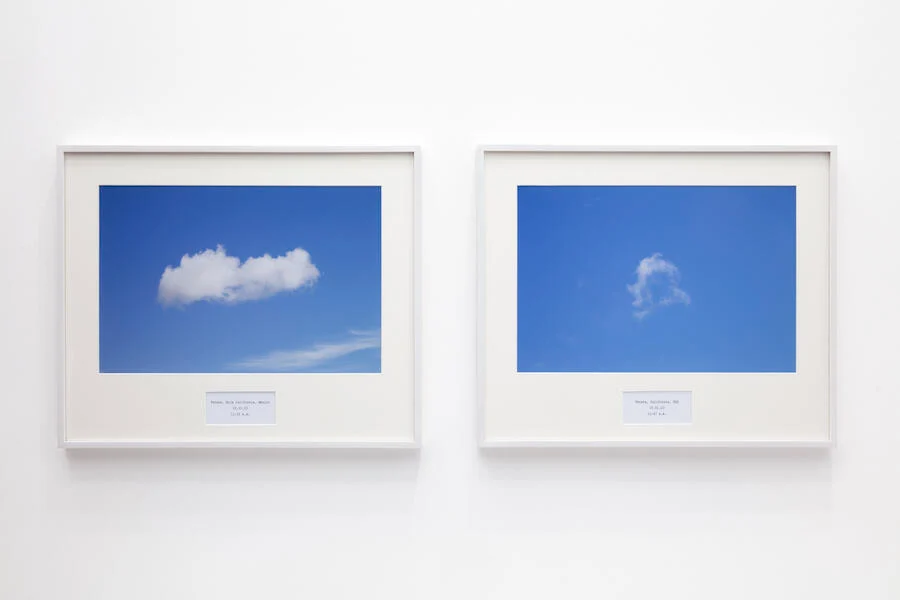
Photographic practice on view at Frieze Los Angeles 2026 spans a formidable array. In diptychs presented by Proyectos Monclova, Chantal Peñalosa points her camera at the sky on the US-Mexico border to capture the same clouds first from Tecate, Baja California, Mexico, then Tecate, California, US. In Peñalosa’s photographs – annotated with their exact date and time – the clouds’ gentle shapeshifting belies the political turmoil below.
The skies are softly veiled in Christina Fernandez’s series ‘View from Here’, in which the LA-based Chicana artist photographs through the windows of historically significant locations across California. Fernandez’s new addition to the series, debuting with Luisotti at the fair, pictures the view from agricultural organizer César Chávez’s Central Valley office, and is accompanied by works from her earlier series ‘Manuela S-T-I-T-C-H-E-D’ (1996–2000), which pairs photographs of the facades of garment factories in East LA with panels of embroidered text narrating the lives of the women who work there – a project that takes on raw significance in the context of the escalating ICE raids in the city and across the US.
Photography’s promise to record has long been questioned by the medium’s practitioners. On Commonwealth and Council’s fair stand, David Alekhuogie reclaims Walker Evans’s 1930s photographs of African art in his own sculptural photocollages to probe questions of heritage and authorship in museums. In Focus with Gordon Robichaux, Uzi Parnes presents his ‘Photo Chandaliers [sic]’ (1984–85), assemblages that combine montaged photographs of men and New York’s piers with found feathers, glitter, fabric and mirror shards.
A different kind of distortion is on view with first-time exhibitors Yancey Richardson and Casemore Gallery, who collaborate on a celebration of Larry Sultan’s lesser-known and -shown series ‘The Valley’ (1997–2003). Photographed on adult film sets in rented middle-class homes in the San Fernando Valley, the series evokes reality, fantasy, sex and domesticity all in uniformly sharp detail. ‘“The Valley” speaks to our more voyeuristic instincts manifest in our current culture,’ says Richardson. ‘It is more relevant to, and deeply resonant with, our time than ever.’
Taka Ishii’s Frieze presentation ‘Photographing = Copying’ dives into unconventional interpretations of the medium, including Kunié Sugiura’s photograms, Daido Moriyama’s spatially condensed urban scenes and Noguchi Rika’s richly coloured macro images. Founded in Tokyo, the gallery has long led the way in positioning photographers, both contemporary and historical, at the heart of its programme. The gallery opened in 1994 with a show of photographer Larry Clark and, in 2011, inaugurated a dedicated space, Taka Ishii Photography / Film, in Tokyo, with a particular emphasis on postwar Japanese photography.
Over the past 15 years, gallery founder Taka Ishii has seen the ‘recognition of the value and durability of vintage photography grow. Many Japanese museums did not consider photography as part of their collections until recently.’ Ishii recognizes the outpouring of new photographers as responsible for the spike in interest in vintage photography: ‘More artists are now working with photographs,’ he says, ‘and an increasing number of museums are starting to collect them.’
‘To collect photographs is to collect the world,’ wrote Susan Sontag in 1977. As the presence and status of photographs continues to rise across museum shows, gallery programmes, art fairs and auctions, more corners of this world come into the light. Photography offers opportunities for creativity and play for collectors and gallerists alike. Lund’s highlight exhibition of 2025 was ‘Seriously’, Sprüth Magers’s recent exploration at its London space of the witty in conceptual photography. Including Keith Arnatt, Laurie Simmons, Peter Fischli and David Weiss, it was ‘a wonderfully risk-taking, rich show’ in a challenging climate for galleries, says Lund. These unexpected perspectives on photography will thrive in the context of soaring interest in the medium. As we get hungrier for ‘something real’, the queues will continue around the block.
No items found.