¿Una escultura sobre lava? La obra secreta de la UNAM construida hace 2 mil años
When you think of UNAM , the first things that usually come to mind are its murals, the Central Library, or the Olympic Stadium. However, within University City there is a place that few know about and that is considered one of the most impressive works of art in Mexico : the Sculpture Center , a space built on volcanic lava formed more than 2,000 years ago
Cuando se piensa en la UNAM, lo primero que suele venir a la mente son sus murales, la Biblioteca Central o el Estadio Olímpico. Sin embargo, dentro de Ciudad Universitaria existe un lugar que pocos conocen y que es considerado una de las obras de arte más impresionantes de México: el Centro Escultórico, un espacio construido sobre lava volcánica formada hace más de 2 mil años.
1.7.2026
Abril Franco
Abril Franco
When you think of UNAM , the first things that usually come to mind are its murals, the Central Library, or the Olympic Stadium. However, within University City there is a place that few know about and that is considered one of the most impressive works of art in Mexico : the Sculpture Center , a space built on volcanic lava formed more than 2,000 years ago.
What is most surprising is that here the artwork is not just a sculpture. In fact, the entire landscape is part of the creation.
The Sculpture Center was inaugurated in 1979 and was born thanks to the collaboration of six renowned Mexican artists: Helen Escobedo, Sebastián, Federico Silva, Manuel Felguérez, Hersúa and Mathias Goeritz, who sought to break with the traditional idea of placing a sculpture on a pedestal.
His proposal was much more ambitious: to transform the volcanic terrain of Pedregal de San Ángel into a gigantic piece of art that would coexist with nature.
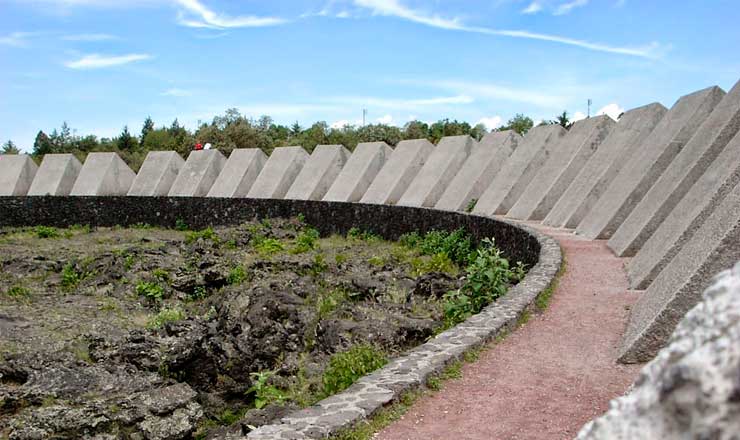
The most striking feature of the site is a massive concrete ring, approximately 120 meters in diameter, surrounding a core of completely natural vegetation. From above, the structure appears almost perfect, resembling a huge geometric figure that contrasts sharply with the black volcanic rock landscape.
But the true meaning of the Sculpture Center goes far beyond its form. The project seeks to showcase the relationship between humankind, art, and nature, respecting the original terrain without altering the essence of the place.
The entire complex was built on the lava flows left by the eruption of the Xitle volcano, which occurred approximately two thousand years ago. That eruption gave rise to the famous Pedregal de San Ángel , one of the most important geological areas in Mexico City, which, centuries later, would become the site of University City (Ciudad Universitaria).
Therefore, those who visit this space not only see a work of art, but also walk on a surface formed by one of the most important natural phenomena in the history of the Valley of Mexico.
Many visitors arrive expecting to find a traditional sculpture and end up discovering a place where the landscape, vegetation, volcanic rock and architecture form a single piece.
Despite its immense artistic and cultural value, the Sculpture Center remains one of the lesser-known corners of UNAM . However, for those who enjoy architecture, contemporary art, photography, or simply want to discover different places in Mexico City, it's practically a must-see.
Cuando se piensa en la UNAM, lo primero que suele venir a la mente son sus murales, la Biblioteca Central o el Estadio Olímpico. Sin embargo, dentro de Ciudad Universitaria existe un lugar que pocos conocen y que es considerado una de las obras de arte más impresionantes de México: el Centro Escultórico, un espacio construido sobre lava volcánica formada hace más de 2 mil años.
Lo más sorprendente es que aquí la obra de arte no es únicamente una escultura. En realidad, el paisaje completo forma parte de la creación.
El Centro Escultórico fue inaugurado en 1979 y nació gracias a la colaboración de seis reconocidos artistas mexicanos: Helen Escobedo, Sebastián, Federico Silva, Manuel Felguérez, Hersúa y Mathias Goeritz, quienes buscaron romper con la idea tradicional de colocar una escultura sobre un pedestal.
Su propuesta fue mucho más ambiciosa: convertir el terreno volcánico del Pedregal de San Ángel en una gigantesca pieza de arte que conviviera con la naturaleza.
El elemento más llamativo del lugar es un enorme anillo de concreto de aproximadamente 120 metros de diámetro, que rodea un núcleo de vegetación completamente natural. Desde las alturas, la estructura luce casi perfecta y parece una enorme figura geométrica que contrasta con el paisaje negro de la roca volcánica.
Pero el verdadero significado del Centro Escultórico va mucho más allá de su forma. El proyecto busca mostrar la relación entre el ser humano, el arte y la naturaleza, respetando el terreno original sin modificar la esencia del lugar.
Y es que todo el complejo fue construido sobre la lava que dejó la erupción del volcán Xitle, ocurrida hace aproximadamente dos mil años. Esa erupción dio origen al famoso Pedregal de San Ángel, una de las zonas geológicas más importantes de la Ciudad de México y que, siglos después, se convertiría en el hogar de Ciudad Universitaria.
Por eso, quienes recorren este espacio no solo visitan una obra artística, también caminan sobre una superficie formada por uno de los fenómenos naturales más importantes en la historia del Valle de México.
Muchos visitantes llegan esperando encontrar una escultura tradicional y terminan descubriendo un lugar donde el paisaje, la vegetación, la roca volcánica y la arquitectura forman una sola pieza.
A pesar de su enorme valor artístico y cultural, el Centro Escultórico sigue siendo uno de los rincones menos conocidos de la UNAM. Sin embargo, para quienes disfrutan la arquitectura, el arte contemporáneo, la fotografía o simplemente quieren descubrir lugares diferentes en la Ciudad de México, se trata de una visita prácticamente obligada.
No items found.