A reflection of the reality of ordinary people
Un reflejo de la realidad de las personas comunes
One Among Millions , by Néstor Jiménez, at the MUAC
Uno entre millones, de Néstor Jiménez, en el MUAC
3.2.2026
By: Roberto Frías for Cultura UNAM
Por: Roberto Frías, para Cultura UNAM
“There were more and more of them,” Néstor Jiménez recalls, thinking about the black ribbons on the facades of his neighborhood. “It makes you think about what’s happening. It’s a barometer of social well-being.” There was a time when those mourning ribbons multiplied in his old neighborhood of Coyoacán. The artist decided to count them and paint them. Behind each ribbon is a life that sustained other lives. They are the One Among Millions , the title of his exhibition at the University Museum of Contemporary Art (MUAC), which opens on February 7.
Jiménez (Mexico City, 1988), a graduate of the National School of Painting, Sculpture and Engraving “La Esmeralda”, works on the processes of construction of historical and political memory, the distortions of leftist thought and the political function of the representation of the territory, creating a narrative antagonistic to the state narrative on the historical development of social mobilization.
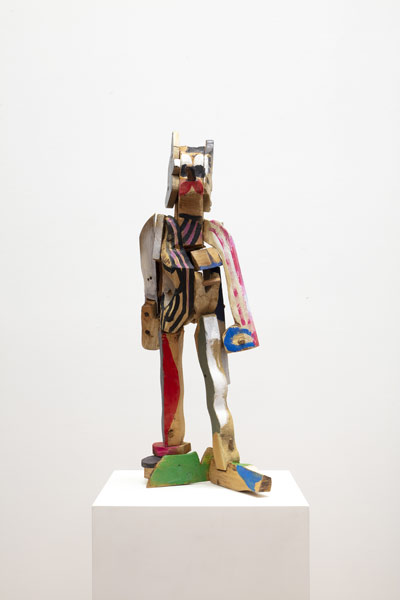
“In Mexico, there are far more unemployed than employed. You can no longer speak of a nation made up of workers when there are no real jobs,” he stated. The contrast is stark: while muralism celebrated the worker as the backbone of the nation, 60% of the population survives today thanks to the informal economy. One Among Millions materializes this fracture in six works ranging from monumental painting to collage , and including kinetic sculpture and ceramics.
“ One in a Million can represent both the outstanding man and the one lost in the crowd,” he explained regarding the ambiguous title. “It might be an arrogant self-proclamation, but it also introduces me to the lives of ordinary working men, just as I still see myself: an ordinary person doing a job ethically.”
The exhibition is part of MUAC's commissioned works program, which since 2024 has supported emerging artists to increase their visibility. Curated by Lucía Sanromán, the exhibition traces what Jiménez calls "the epic of the common man" (food, education, work, death, and memory), the struggles of the average Mexican where precarity is normalized.
“Every life can be extraordinary. Just as it can also be lost in nothingness,” the artist reflected. “People of great social importance, whom no one remembers, compared to the father who is preserved in the collective memory of the family.”
This tension runs through the exhibition, whose central theme is a mortuary portrait: that of the artist's father, a common worker, painted with lapis lazuli, lead white, and vermilion on a pine frame—the wood of coffins. “It was the contrast: the humblest coffin with the pigments most associated with royalty,” he explained.
Six houses adorned with black ribbons comprise "Night of Wake ," documenting hours between six in the evening and five in the morning. "This is happening in the areas with the greatest social mobility," she noted. "The preservation of the black ribbon speaks to the tension between urban and social development." Coyoacán, where she lives and works, embodies this paradox.
“In Mexico, we have this tendency to refer to people who don’t do intellectual work as a form of dehumanization,” she says, speaking about La yunta (The Yoke) , a monumental painting and the centerpiece of the exhibition where giant pencils become tools of oppression. “Donkey ears, the threat of ending up as a porter in La Merced market… as if physical labor banished you from the human world.”
The painting, which depicts concrete, wood, and gravel (materials he became familiar with during his upbringing), engages with Mexican muralism, but from personal experience, not state rhetoric.
In another work, a collage of nearly 300 newspaper figures representing informal workers incorporates a performative and ironic dimension that emerged during its creation, in which the artist worked with an assistant cutting out the figures from newspaper job ads. “We followed the methodology of looking for work: get up early, buy the newspaper, cut out ads,” he recounted.
“We entered the realm of the performativity of unemployment. Within a week, we couldn't find enough advertisements to reach our target number of figures. We were a bundle of nerves because we couldn't resolve the situation, just like the average unemployed worker.” The piece is based on the cutouts Hans Christian Andersen used to illustrate his stories. “For me, it was important to explain that grand tale of social welfare, which is becoming increasingly distant,” he concluded.
Sanromán described the exhibition as “an essay on a vulnerable masculinity caught between the conditions of industrial capitalism and something else yet to be defined.” That something else, marked by digital platforms and automation, is already supplanting the “common man” that Jiménez honors. One Among Millions will be on display in Room 3 of the MUAC until July 3.
Cada vez eran más”, recuerda Néstor Jiménez al pensar en los moños negros en las fachadas de su colonia. “Te da para pensar qué está sucediendo. Es un termómetro del bienestar social”. Hubo una época en que esas cintas de luto se fueron multiplicando en su antiguo barrio de Coyoacán. El artista decidió contarlas y pintarlas. Detrás de cada moño hay una vida que sostuvo otras vidas. Son el Uno entre millones, título de su exposición en el Museo Universitario Arte Contemporáneo (MUAC), que abre el 7 de febrero.
Jiménez (Ciudad de México, 1988), egresado de la Escuela Nacional de Pintura, Escultura y Grabado “La Esmeralda”, trabaja sobre los procesos de construcción de la memoria histórica y política, las distorsiones del pensamiento de izquierda y la función política de la representación del territorio, creando un relato antagónico al estatal sobre el desarrollo histórico de la movilización social.
“En México hay muchos más desempleados que empleados. Ya no puedes hablar de una nación constituida por trabajadores cuando no hay realmente empleo”, afirmó. El contraste es brutal: mientras el muralismo celebraba al trabajador como eje de la nación, 60 % de la población sobrevive hoy gracias a la economía informal. Uno entre millones materializa esta fractura en seis obras que van de la pintura monumental al collage, pasando por la escultura cinética y la cerámica.
“Uno entre millones puede representar al hombre destacado, al mismo tiempo que al perdido en la masa”, explicó sobre el título ambiguo. “Puede ser una autoproclamación arrogante, pero también me introduce en la vida de los hombres trabajadores comunes, tal como me sigo asumiendo: una persona común que realiza un trabajo con ética”.
La muestra forma parte del programa de obra comisionada del MUAC, que desde 2024 impulsa artistas jóvenes para aumentar su proyección. Bajo la curaduría de Lucía Sanromán, la exposición traza lo que Jiménez llama “la epopeya del hombre común” (alimentación, educación, trabajo, muerte y memoria), las batallas del mexicano promedio donde la precariedad se normaliza.
“Toda vida puede ser extraordinaria. Así como también puede perderse en la nada”, reflexionó el artista. “Gente con mucha importancia social, de la que nadie se acuerda, frente al padre que se preserva en la memoria colectiva de la familia”.
Esta tensión atraviesa la exposición, cuyo eje es un retrato mortuorio: el del padre del artista, trabajador común, pintado con lapislázuli, blanco de plomo y bermellón sobre un bastidor de pino: la madera de los ataúdes. “Era el contraste: el ataúd más humilde con los pigmentos más asociados a la realeza”, precisó.
Seis casas con moños negros componen Noche de velorio, documentando horas entre las seis de la tarde y las cinco de la mañana. “En las zonas más versátiles en movilidad social es donde esto está sucediendo”, señaló. “La preservación del moño negro te habla de la tensión entre desarrollo urbano y el social”. Coyoacán, donde vive y trabaja, concentra esa paradoja.
“Tenemos en México esta cuestión de referirnos a las personas que no realizan trabajo intelectual como un proceso de animalización”, denuncia al hablar de La yunta, pintura monumental y pieza central de la muestra donde lápices gigantes se convierten en herramienta de opresión. “Las orejas de burro, la amenaza de acabar de cargador en La Merced… como si el trabajo físico te desterrara del mundo de lo humano”.
El cuadro, en el que se representan el concreto, la madera y la grava (materiales con los que se familiarizó durante su crianza), dialoga con el muralismo mexicano, pero desde la experiencia personal, no la retórica estatal.
En otra obra, un collage de casi 300 figuras de papel periódico que representa trabajadores informales incorpora una dimensión performática e irónica que se dio durante su elaboración, en la que el artista trabajó con una asistente recortando las figuras a partir de anuncios de trabajo de los periódicos. “Seguíamos la metodología de buscar trabajo: levantarse temprano, comprar el periódico, recortar anuncios”, relató.
“Entramos en la performatividad del desempleo. A la semana no hallábamos suficientes anuncios para lograr la meta que nos habíamos propuesto sobre el número de figuras. Éramos un nudo de nervios porque no lográbamos resolver la situación, como el trabajador desempleado común”. La pieza se basa en los recortes que Hans Christian Andersen usaba para ilustrar cuentos. “Para mí era importante explicar ese gran cuento del bienestar social que cada vez es más lejano”, concluyó.
Sanromán describió la muestra como “un ensayo sobre una masculinidad vulnerable capturada entre las condiciones del capitalismo industrial y otra cosa aún por definir”. Esa otra cosa, marcada por las plataformas digitales y la automatización, ya suplanta al “hombre común” que Jiménez honra. Uno entre millones estará en exhibición en la Sala 3 del MUAC hasta el 3 de julio.
No items found.