Rising Painter Hilda Palafox Is Reimagining Mexican Muralism for the 21st Century
La pintora emergente Hilda Palafox está reinterpretando el muralismo mexicano para el siglo XXI
14.1.2026
Sadaf Padder
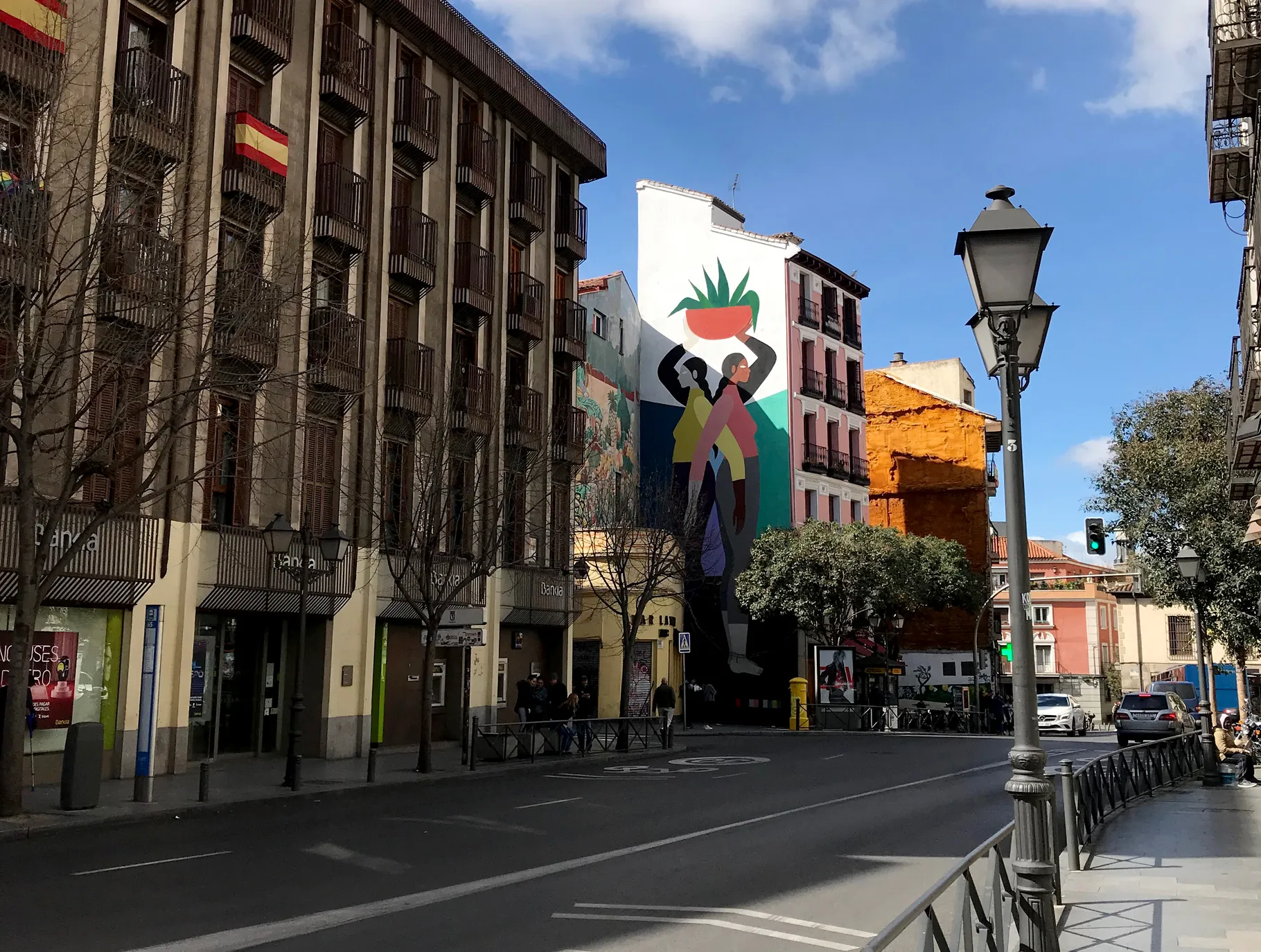
One of Hilda Palafox’s early murals, painted in 2019 on the side of a residential building above a café in Madrid’s La Latina neighborhood, depicts two elongated female figures standing back-to-back, their bodies interlocked as they balance a shallow bowl of fruit overhead. The figures’ simplified silhouettes and interaction with a man-made object anticipate a visual language that would come to define her work—one rooted in balance, attentiveness, and feminine interdependence.
Living and working in Mexico City, Palafox has been shaped by the city’s modernist architecture and monumental public art. “In Mexico, muralism has a deep history,” Palafox said in an interview with Artsy. “The Mexican muralism movement was about education for everyone, about beauty in daily life.”
Now, Palafox’s practice, with its muralist inspirations, has gained increasing international visibility. She has exhibited widely across Mexico and the United States as well as further afield, and is represented by Proyectos Monclova. When we spoke, the artist was preparing for a New York solo exhibition, “De Tierra y Susurros (Of Soil and Whispers),” which opened January 9th at Sean Kelly Gallery. “I’m nervous—in a good way,” she admitted with a smile. The exhibition brings together a new body of paintings and works on paper with “Portales,” a series of stone reliefs carved from cantera—a lightweight volcanic stone long used in Mexican architecture. Together, these works shift the site of monumentality from scale to sensation. “My work is always an invitation to look inside,” she said. “To be more gentle with what’s going on outside.”
Emerging in the early 20th century, Mexican muralism sought to make art accessible beyond institutional spaces, using public walls to address history, social struggle, and collective memory. Palafox cites figures such as José Vasconcelos, Jorge González Camarena, Juan O’Gorman, and, in particular, Carlos Mérida, whose abstraction of the human figure into simple, modular forms expanded muralism beyond narrative realism toward symbolic geometry.
Palafox has been drawing for as long as she can remember. But it wasn’t until 2016, when she began painting murals, that her practice fully opened up. “I always loved making things with my hands,” she said, reflecting on her childhood growing up in Mexico City. “In high school, I had many friends who were into art, but I didn’t know what it meant to be a painter. I didn’t have that contemporary view yet.”
She went on to study design at the Instituto Nacional de Bellas Artes (INBA), drawn to its tactile, hands-on approach, where graphic, industrial, and textile design were all taught together. After graduating, Palafox worked briefly in advertising before turning to illustration, a shift that brought her closer to storytelling and image-making.
For Palafox, mural painting offered something illustration could not: physicality, scale, and a direct relationship with public space. “My illustration work was more alone in the studio,” she said. “When you work on murals, you’re outside, among people, using your whole body.”
Meanwhile in the studio, Palafox gravitated toward larger canvases, translating the physicality of mural-making into painting. What began as a graphic style gradually became more fluid and layered. The transition from acrylics to oil opened, as she put it, “a whole new universe.” Color deepened to earthen tones and subtle contrasts, edges softened, and surfaces gained texture and density. “When you hear ‘nature,’ most people think of green,” she noted, “but I wanted to work with soil and earthy tones. There’s heat in everything now.”
Her current studio, a small apartment she rents from her sister in Mexico City’s Narvarte neighborhood, is just a short walk from her home. A jacaranda tree blooms outside the window, bringing a sense of serenity into the space. “At some point, I would love to have a big space for more explosive creation,” Palafox admitted. “For now, it works.”
In the painting Susurros I (2025), two women lie on cracked ground, their ears pressed to the earth, figures and landscape melding into a shared, heat-worn terrain, as a small plant grows between their joined hands. The composition privileges listening over action, framing attention as a form of care. “It’s not only about life or procreation,” Palafox said. “It’s about knowledge—about pulling something from within.”
That language of touch is also visible in Ritual a las faldas de un volcán (2025), a large-scale composition depicting multiple figures gathered at the base of a smoldering volcano, moving together in a circular dance. “Las faldas” refers both to a skirt and to the lower slopes of a volcano, introducing layered symbolism: The volcano is a site of danger and fertility, destruction and renewal. “The ground of the volcano explodes,” she noted, “and the earth where the lava goes is very fertile. A new beginning.” The work signals an expansion of her practice, as Palafox embraces greater material density and painterly flow.
“I want people to pause, to listen,” Palafox said. “To see that we are part of something living.” In “De Tierra y Susurros,” that invitation feels especially resonant. Across painting, paper, and stone, her figures merge with land—rooted, patient and quietly attentive. The works linger, somewhere between soil and skin, asking that you stay with them a little while.
Uno de los primeros murales de Hilda Palafox, pintado en 2019 en el costado de un edificio residencial sobre un café en el barrio de La Latina, en Madrid, representa a dos figuras femeninas alargadas que se sostienen espalda con espalda, con los cuerpos entrelazados mientras equilibran un cuenco poco profundo con fruta sobre sus cabezas. Las siluetas simplificadas de las figuras y su interacción con un objeto creado por el ser humano anticipan un lenguaje visual que llegaría a definir su obra: uno arraigado en el equilibrio, la atención y la interdependencia femenina.
Viviendo y trabajando en la Ciudad de México, Palafox ha sido moldeada por la arquitectura modernista de la ciudad y su arte público monumental. “En México, el muralismo tiene una historia muy profunda”, dijo Palafox en una entrevista con Artsy. “El movimiento muralista mexicano trataba sobre la educación para todos, sobre la belleza en la vida cotidiana”.
Hoy, la práctica de Palafox, con claras inspiraciones muralistas, ha ganado una creciente visibilidad internacional. Ha expuesto ampliamente en México y Estados Unidos, así como en otros países, y está representada por Proyectos Monclova. Cuando conversamos, la artista se preparaba para su exposición individual en Nueva York, De Tierra y Susurros (Of Soil and Whispers), inaugurada el 9 de enero en Sean Kelly Gallery. “Estoy nerviosa —en el buen sentido”, admitió con una sonrisa.
La exposición reúne un nuevo cuerpo de pinturas y obras sobre papel junto con Portales, una serie de relieves en piedra tallados en cantera, una piedra volcánica ligera utilizada desde hace mucho tiempo en la arquitectura mexicana. En conjunto, estas obras desplazan la idea de monumentalidad de la escala a la sensación. “Mi trabajo es siempre una invitación a mirar hacia adentro”, dijo. “A ser más gentiles con lo que sucede afuera”.
Surgido a principios del siglo XX, el muralismo mexicano buscó hacer el arte accesible más allá de los espacios institucionales, utilizando muros públicos para abordar la historia, la lucha social y la memoria colectiva. Palafox cita figuras como José Vasconcelos, Jorge González Camarena, Juan O’Gorman y, en particular, Carlos Mérida, cuya abstracción de la figura humana en formas simples y modulares expandió el muralismo más allá del realismo narrativo hacia una geometría simbólica.
Palafox ha dibujado desde que tiene memoria. Sin embargo, no fue sino hasta 2016, cuando comenzó a pintar murales, que su práctica se abrió por completo. “Siempre me gustó hacer cosas con las manos”, recordó al reflexionar sobre su infancia en la Ciudad de México. “En la preparatoria tenía muchos amigos interesados en el arte, pero no sabía qué significaba ser pintora. Aún no tenía esa visión contemporánea”.
Posteriormente estudió diseño en el Instituto Nacional de Bellas Artes (INBA), atraída por su enfoque táctil y práctico, donde el diseño gráfico, industrial y textil se enseñaban de manera integrada. Tras graduarse, Palafox trabajó brevemente en publicidad antes de volcarse hacia la ilustración, un cambio que la acercó más a la narración y a la creación de imágenes.
Para Palafox, la pintura mural ofrecía algo que la ilustración no podía: fisicalidad, escala y una relación directa con el espacio público. “Mi trabajo como ilustradora era más solitario, dentro del estudio”, explicó. “Cuando trabajas en murales, estás afuera, entre la gente, usando todo el cuerpo”.
Mientras tanto, en el estudio, Palafox comenzó a inclinarse por lienzos de mayor formato, trasladando la fisicalidad del mural a la pintura. Lo que comenzó como un estilo gráfico se volvió gradualmente más fluido y estratificado. La transición del acrílico al óleo abrió, como ella lo describe, “todo un nuevo universo”. El color se profundizó hacia tonos terrosos y contrastes sutiles, los bordes se suavizaron y las superficies adquirieron textura y densidad. “Cuando se escucha la palabra ‘naturaleza’, la mayoría de la gente piensa en verde”, señaló, “pero yo quería trabajar con el suelo y los tonos de la tierra. Ahora hay calor en todo”.
Su estudio actual, un pequeño departamento que renta a su hermana en la colonia Narvarte, en la Ciudad de México, se encuentra a pocos minutos a pie de su casa. Un árbol de jacaranda florece frente a la ventana, aportando una sensación de serenidad al espacio. “En algún momento me encantaría tener un espacio grande para una creación más explosiva”, confesó Palafox. “Por ahora, funciona”.
En la pintura Susurros I (2025), dos mujeres yacen sobre un suelo agrietado, con los oídos pegados a la tierra; figuras y paisaje se funden en un terreno compartido, marcado por el calor, mientras una pequeña planta crece entre sus manos entrelazadas. La composición privilegia la escucha sobre la acción, enmarcando la atención como una forma de cuidado. “No se trata solo de la vida o la procreación”, dijo Palafox. “Se trata del conocimiento, de extraer algo desde dentro”.
Ese lenguaje del tacto también es visible en Ritual a las faldas de un volcán (2025), una composición de gran formato que representa a múltiples figuras reunidas en la base de un volcán humeante, moviéndose juntas en una danza circular. “Las faldas” se refiere tanto a una prenda como a las laderas de un volcán, introduciendo un simbolismo múltiple: el volcán es un sitio de peligro y fertilidad, destrucción y renovación. “El suelo del volcán explota”, señaló, “y la tierra por donde pasa la lava es muy fértil. Un nuevo comienzo”.
La obra señala una expansión de su práctica, en la que Palafox abraza una mayor densidad material y un flujo pictórico más libre. “Quiero que la gente se detenga, que escuche”, dijo. “Que vea que somos parte de algo vivo”. En De Tierra y Susurros, esa invitación resulta especialmente resonante. A través de pintura, papel y piedra, sus figuras se funden con la tierra: arraigadas, pacientes y silenciosamente atentas. Las obras permanecen, en algún punto entre el suelo y la piel, pidiendo que uno se quede con ellas un poco más.
No items found.