Helen Escobedo: the Mexican sculptor who reinvented public space
Helen Escobedo: la escultora mexicana que reinventó el espacio público
The question of who Helen Escobedo, the sculptor, was has a clear answer: she was a Mexican artist (1934-2010) who worked for over fifty years in monumental sculpture, installation, drawing, and environmental art
Quien fue Helen Escobedo escultora tiene una respuesta concreta: fue una artista mexicana (1934-2010) que trabajó durante más de cincuenta años en escultura monumental, instalación, dibujo y arte ambiental.
31.7.2026
Irinea Funes
Irinea Funes
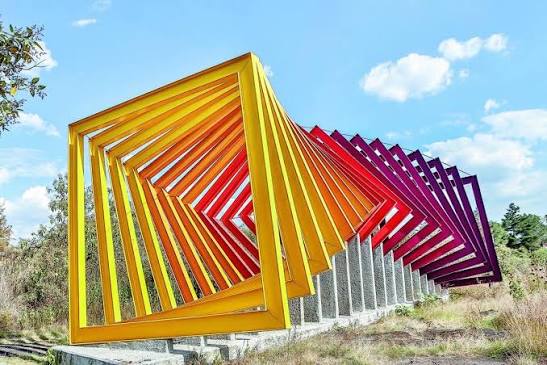
The question of who Helen Escobedo, the sculptor, was has a clear answer: she was a Mexican artist (1934-2010) who worked for over fifty years in monumental sculpture, installation, drawing, and environmental art. Her best-known work, Cóatl (1980), a serpent made of twisted and painted frames approximately 15 meters long, is permanently installed in the Sculpture Garden at the National Autonomous University of Mexico (UNAM). Puertas al viento (1968), two reinforced concrete walls around 16 meters high, still stands on the Route of Friendship in Tlalpan. She received the National Prize for Sciences and Arts in 2009, a year before her death.
If you don't know her, it's no accident. For decades, the narrative of 20th-century Mexican art privileged mural painting and a handful of male names. Escobedo worked in public sculpture, ephemeral installations, and land art—formats that took longer to be included in art textbooks—and she also directed museums, which led to her being remembered more as an administrator than as an artist. Her archive is at the MUAC (University Museum of Contemporary Art), and her work remains in the streets, visible and free. The issue was never the work itself.
The story behind
Escobedo was born in 1934 to a Mexican father and an English mother. At the age of 15, she began studying sculpture with Germán Cueto at Mexico City College. Between 1951 and 1954, she studied at the Royal College of Art in London, where she encountered the work of Epstein, Zadkine, and Henry Moore. Upon returning to Mexico, she exhibited expressionist bronze figures at the Galería de Arte Mexicano.
In 1961, she assumed the directorship of the Department of Visual Arts at UNAM, a position she held until 1979. From there, she promoted the Independent Salons and the first exhibitions of conceptual art in Mexico—while continuing to produce her own work. In 1968, Mathias Goeritz invited her to participate in the Route of Friendship, the monumental sculpture program created for the Mexico City Olympic Games. Escobedo created Puertas al viento (Doors to the Wind ), her first urban-scale piece.
In 1979, she co-designed the Sculpture Garden at University City, a ring of 64 volcanic concrete modules surrounding an untouched fragment of volcanic rock. The following year, she installed Cóatl in the same location, this time as a solo work. In 1991, with a Guggenheim Fellowship, she created Black Trash, Black Tomorrow in Chapultepec Park: one hundred feet of trash painted black, which remained on display for three days. She also directed the Museum of Modern Art and the Institute of Aesthetic Research at UNAM (National Autonomous University of Mexico). From 1986, she was a lifetime member of the Royal Academy of Sciences, Letters and Fine Arts of Belgium. She died in Mexico City on September 16, 2010.
What are you watching?
- Doors to the Wind (1968): the central medallion suspended between the two vertical concrete walls. It was conceived to reflect the alfalfa fields that then surrounded Granjas Coapa—that landscape no longer exists, but the structure continues to dialogue with the open sky.
- Cóatl (1980): twisted metal frames painted in a gradient of colors. Viewed from different angles, the frames overlap and the solid form dissolves: the serpent only exists completely if the viewer moves around it.
- Sculptural Space (1979): the ring of volcanic concrete modules that delimits the rocky area without enclosing it. Escobedo was a co-author of the ensemble; her individual contribution to the design is rarely distinguished from the collective work on the site's posters.
- Black Trash, Black Tomorrow (1991): an ephemeral installation one hundred feet long that lasted only three days. The color black unified heterogeneous waste into a landscape form; it disappeared, but the pollution problem it highlighted did not.
- I, Monument! (1979): a collage in which Escobedo photographed herself on a pedestal, replacing the national hero. It is an ironic gesture that anticipates decades of debate about who occupies monumental space in Mexico.
What does each element mean?
Cóatl means serpent in Nahuatl. The form alludes to Mesoamerican iconography, but Escobedo executed it in painted steel, not stone. According to Proyectos Monclova, the tension between the indigenous reference and the industrial material is deliberate: it is not an archaeological reference, but a conversation between eras.
Doors to the Wind was conceived to be visually experienced, not admired head-on. According to an analysis by AWARE Women Artists, the title alludes to movement and openness, moving away from the static monument-object that dominated public sculpture of its time.
In Black Trash, Black Tomorrow , the color black is not decorative: it unifies disparate materials into a single form and transforms urban waste into land art. The work highlighted the ecological crisis of Mexico City in the 1990s, according to La Jornada (2010).
"I, Monument!" is the most explicit piece: Escobedo occupies the empty pedestal of the male hero. According to Artforum (2019), the critique of the official monument as a device of state power is direct and requires no mediation.
What is repeated but is not true
Myth: The UNAM Sculpture Garden is a work by Mathias Goeritz. It is a collaborative work, co-authored by several artists. Helen Escobedo is listed as a co-author of the project along with other artists. Goeritz participated, but the authorship is shared. Sources: Museo Amparo (institutional information sheet), libros.unam.mx, Proyectos Monclova.
Myth: Escobedo was primarily a cultural manager, not an artist. She directed institutions alongside her active artistic practice. The Helen Escobedo Collection at MUAC includes sketches, logbooks, and project drawings from that same period. Sources: MUAC/UNAM, Arkheia Documentation Center; Artforum (obituary, 2010).
Myth: Her public work is limited to Mexico. Escobedo produced permanent public sculptures in Cuba, England, New Zealand, Israel, and the United States, in addition to Mexico. Sources: Government of Mexico City, AWARE Women Artists.
Where to watch it
Cóatl is permanently installed in the Sculpture Garden at University City, UNAM, Mexico City. It is free and open to the public. Puertas al viento (Doors to the Wind) is on display along the Route of Friendship in Tlalpan, Mexico City, also with public access. The Helen Escobedo Collection —sketches, photographs, newspaper clippings, logbooks, and exhibition projects—can be consulted at the Arkheia Documentation Center of the MUAC, UNAM. The MUAC also has a professorship named after her. Museums rotate exhibitions and loan works; it is advisable to check availability before visiting.
Quick questions
When did Helen Escobedo die?
He died in Mexico City on September 16, 2010.
What is the Friendship Route and what does it have to do with?
It is a monumental sculpture program created for the 1968 Mexico Olympic Games. Escobedo participated with Puertas al viento (Doors to the Wind ), his first urban-scale piece, at the invitation of Mathias Goeritz.
Where is Helen Escobedo's file?
At the Arkheia Documentation Center of the MUAC, UNAM, Mexico City, where the Helen Escobedo Collection is preserved with sketches, photographs, logbooks and projects.
Technical specifications
- Author: Helen Escobedo
- Year: 1934-2010 (active work c. 1954-2010)
- Technique: Monumental sculpture in reinforced concrete, steel, fiberglass, PVC; ephemeral installation; drawing; collage
- Measurements: Variable depending on the project. Openings: ~16 m high (reinforced concrete). Coatl: ~15 m long
- Movement: Monumental sculpture / Land art / Environmental art / Site-specific art
- Where it is: Sculpture Garden, University City, UNAM, Mexico City (Cóatl, permanent). Route of Friendship, Tlalpan, Mexico City (Doors to the Wind, permanent). Helen Escobedo Collection: MUAC, UNAM, Mexico City
Quien fue Helen Escobedo escultora tiene una respuesta concreta: fue una artista mexicana (1934-2010) que trabajó durante más de cincuenta años en escultura monumental, instalación, dibujo y arte ambiental. Su obra más conocida, Cóatl (1980), una serpiente de marcos torcionados y pintados de aproximadamente 15 metros de longitud, está instalada de forma permanente en el Espacio Escultórico de Ciudad Universitaria. Puertas al viento (1968), dos muros de concreto armado de alrededor de 16 metros de altura, sigue en pie en la Ruta de la Amistad, en Tlalpan. Recibió el Premio Nacional de Ciencias y Artes en 2009, un año antes de morir.
Si no la conoces, no es un accidente. Durante décadas, el relato del arte mexicano del siglo XX privilegió la pintura muralista y a un puñado de nombres masculinos. Escobedo trabajó en escultura pública, en instalación efímera y en land art —formatos que tardaron más en entrar a los manuales— y además dirigió museos, lo que hizo que se le recordara más como funcionaria que como artista. Su archivo está en el MUAC y su obra sigue en la calle, visible y gratuita. El problema nunca fue la obra.
La historia detrás
Escobedo nació en 1934, hija de padre mexicano y madre inglesa. A los 15 años comenzó a estudiar escultura con Germán Cueto en el Mexico City College. Entre 1951 y 1954 cursó en el Royal College of Art de Londres, donde entró en contacto con la obra de Epstein, Zadkine y Henry Moore. Al volver a México expuso figuras expresionistas en bronce en la Galería de Arte Mexicano.
En 1961 asumió la dirección del Departamento de Artes Plásticas de la UNAM, cargo que mantuvo hasta 1979. Desde ahí impulsó los Salones Independientes y las primeras exposiciones de arte conceptual en México —sin dejar de producir obra propia. En 1968, Mathias Goeritz la invitó a participar en la Ruta de la Amistad, el programa de escultura monumental creado para los Juegos Olímpicos de México. Escobedo realizó Puertas al viento, su primera pieza a escala urbana.
En 1979 fue coautora del Espacio Escultórico de Ciudad Universitaria, el anillo de 64 módulos de concreto volcánico que rodea un fragmento de pedregal intacto. Al año siguiente instaló Cóatl en ese mismo recinto, esta vez como obra individual. En 1991, con la beca Guggenheim, realizó Negro basura, negro mañana en el Bosque de Chapultepec: cien pies de basura pintada de negro que duró tres días. También dirigió el Museo de Arte Moderno y el Instituto de Investigaciones Estéticas de la UNAM. Desde 1986 fue miembro vitalicia de la Real Academia de Ciencias, Letras y Bellas Artes de Bélgica. Murió en Ciudad de México el 16 de septiembre de 2010.
Qué estás viendo
- Puertas al viento (1968): el medallón central suspendido entre los dos muros verticales de concreto. Fue concebido para reflejar los campos de alfalfa que entonces rodeaban Granjas Coapa —ese paisaje ya no existe, pero la estructura sigue dialogando con el cielo abierto.
- Cóatl (1980): los marcos metálicos torcionados y pintados en degradado de colores. Vistos desde distintos ángulos, los marcos se superponen y la forma sólida se disuelve: la serpiente solo existe completa si el espectador se mueve alrededor de ella.
- Espacio Escultórico (1979): el anillo de módulos de concreto volcánico que delimita el pedregal sin cercarlo. Escobedo fue coautora del conjunto; su aportación individual al diseño rara vez se distingue de la obra colectiva en los carteles del lugar.
- Negro basura, negro mañana (1991): una instalación efímera de cien pies de largo que duró solo tres días. El color negro unificaba desechos heterogéneos en una forma paisajística; desapareció, pero el problema de contaminación que señalaba no lo hizo.
- Yo, monumento! (1979): un collage en el que Escobedo se fotografió a sí misma sobre un pedestal, sustituyendo al héroe nacional. Es un gesto irónico que anticipa décadas de debate sobre quién ocupa el espacio monumental en México.
Qué significa cada elemento
Cóatl significa serpiente en náhuatl. La forma remite a la iconografía mesoamericana, pero Escobedo la ejecutó en acero pintado, no en piedra. Según Proyectos Monclova, la tensión entre el referente indígena y el material industrial es deliberada: no es una cita arqueológica, es una conversación entre tiempos.
Puertas al viento fue concebida para ser atravesada visualmente, no admirada de frente. Según el análisis de AWARE Women Artists, el título alude al movimiento y la apertura, alejándose del monumento-objeto estático que dominaba la escultura pública de su época.
En Negro basura, negro mañana, el color negro no es decorativo: unifica materiales dispares en una sola forma y convierte la basura urbana en land art. La obra señalaba la crisis ecológica de la Ciudad de México de los años noventa, según La Jornada (2010).
Yo, monumento! es la pieza más explícita: Escobedo ocupa el pedestal vacío del héroe masculino. Según Artforum (2019), la crítica al monumento oficial como dispositivo de poder estatal es directa y no necesita mediación.
Lo que se repite y no es cierto
Mito: el Espacio Escultórico de la UNAM es una obra de Mathias Goeritz. Es una obra colectiva en coautoría. Helen Escobedo figura como coautora del proyecto junto a otros artistas. Goeritz participó, pero la autoría es compartida. Fuentes: Museo Amparo (ficha institucional), libros.unam.mx, Proyectos Monclova.
Mito: Escobedo fue principalmente gestora cultural, no artista. Dirigió instituciones en paralelo a su práctica artística activa. El Fondo Helen Escobedo en el MUAC incluye bocetos, bitácoras y proyectos de obra de ese mismo periodo. Fuentes: MUAC/UNAM, Centro de Documentación Arkheia; Artforum (obituario, 2010).
Mito: su obra pública se limita a México. Escobedo produjo esculturas públicas permanentes en Cuba, Inglaterra, Nueva Zelanda, Israel y Estados Unidos, además de México. Fuentes: Gobierno de la Ciudad de México, AWARE Women Artists.
Dónde verla
Cóatl está instalada de forma permanente en el Espacio Escultórico de Ciudad Universitaria, UNAM, Ciudad de México. El acceso es público y gratuito. Puertas al viento permanece en la Ruta de la Amistad, Tlalpan, Ciudad de México, también de acceso público. El Fondo Helen Escobedo —bocetos, fotografías, hemerografía, bitácoras y proyectos de exposición— se consulta en el Centro de Documentación Arkheia del MUAC, UNAM. El MUAC tiene además una cátedra con su nombre. Los museos rotan salas y prestan obras: conviene verificar disponibilidad antes de visitar.
Preguntas rápidas
¿Cuándo murió Helen Escobedo?
Murió en Ciudad de México el 16 de septiembre de 2010.
¿Qué es la Ruta de la Amistad y qué tiene que ver con ella?
Es un programa de escultura monumental creado para los Juegos Olímpicos de México 1968. Escobedo participó con Puertas al viento, su primera pieza a escala urbana, por invitación de Mathias Goeritz.
¿Dónde está el archivo de Helen Escobedo?
En el Centro de Documentación Arkheia del MUAC, UNAM, Ciudad de México, donde se conserva el Fondo Helen Escobedo con bocetos, fotografías, bitácoras y proyectos.
Ficha técnica
- Autor: Helen Escobedo
- Año: 1934-2010 (obra activa c. 1954-2010)
- Técnica: Escultura monumental en concreto armado, acero, fibra de vidrio, PVC; instalación efímera; dibujo; collage
- Medidas: Variable según obra. Puertas al viento: ~16 m de altura (concreto armado). Cóatl: ~15 m de longitud
- Movimiento: Escultura monumental / Land art / Arte ambiental / Arte de sitio específico
- Dónde está: Espacio Escultórico, Ciudad Universitaria, UNAM, Ciudad de México (Cóatl, permanente). Ruta de la Amistad, Tlalpan, Ciudad de México (Puertas al viento, permanente). Fondo Helen Escobedo: MUAC, UNAM, Ciudad de México
No items found.