Guillermo García Cruz arrives in Mexico with interruption as his method
Guillermo García Cruz llega a México con la interrupción como método
13.9.2026
Gabriela Gorab
Gabriela Gorab
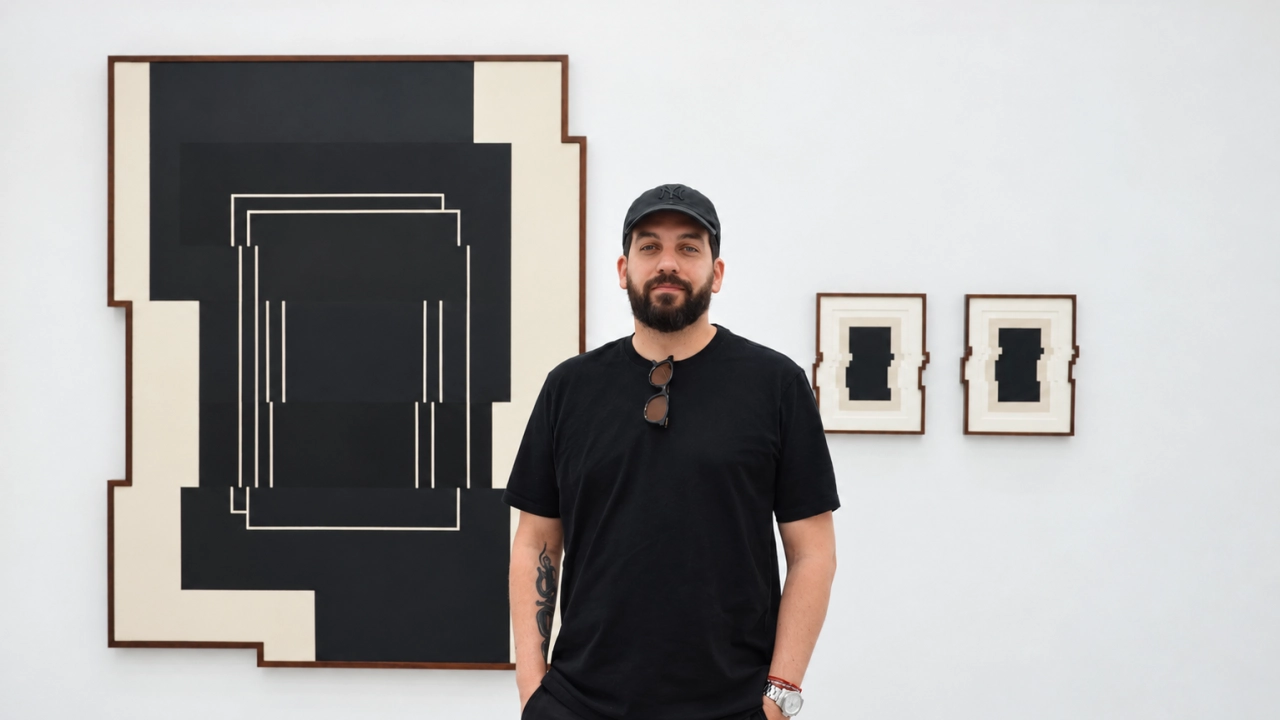
Uruguayan artist Guillermo García Cruz (Montevideo, 1988) spent his early years as a figurative painter before turning to geometric abstraction , but not toward the more established path of Joaquín Torres-García's legacy: he was interested in concrete art and, in particular, the tenets of the Madí movement . In his works, this tradition intersects with digital error, the glitch , to explore how we construct thought today: fragmented, superimposed, mediated by screens. "Interrupted Images"—his first solo exhibition in Mexico, presented by Proyectos Monclova and open until October 24— is also his formal introduction to the Mexican public.
How has your relationship with glitch changed from when you started using it to this sample?
At first, I was interested in it as a metaphor for error as a possibility for change , not as a permanent rupture. Over time, that didn't disappear, but it became more complex: in "Interrupted Images," the glitch also functions as a metaphor for how we construct contemporary thought, in a fragmented and non-linear way. We are constantly receiving images and information that interrupt each other. Added to that is uncertainty, the unpredictable. If we continue to understand reality as something fixed and stable, we will probably end up increasingly disoriented. Today, the glitch is no longer just the error, but the possibility of inhabiting a changing reality without needing to immediately make it stable.
Madí proposed breaking with the rectangular shape of the painting. What do you take from that tradition and what do you change?
It's a very important regional reference for me, both formally and conceptually: that break with the traditional limits of painting , where the composition is no longer contained within a rectangle and ends up determining the physical form of the work. I take that vocabulary, but not to reproduce it, rather to record a current reality. The breaks in the support may allude to that genealogy, but in my work they are linked to glitch, to screens, to our current way of processing images . I'm very interested in that relationship between the internal and the external: just as an alteration within the image modifies the contour of the work, changes in how we construct thought produce effects outward, in how we relate to others.
What interrupts your images today, in 2026?
he widespread adoption of artificial intelligence has introduced a disturbing shift that I increasingly incorporate into this discussion. It changes the rules of the game. Faced with technologies capable of producing images and delegating processes we previously understood as exclusively human, I am increasingly interested in emphasizing the gestural and human presence within my work . I am not interested in using artificial intelligence as a creator. There is something paradoxical: as the images I construct become more fragmented and distorted, I feel a greater need for the human presence to remain visible within them. The glitch that appears in my work today is increasingly consciously reasoned, represented, and produced by a human being.
Why Monclova Projects, why Mexico, why now?
My relationship with Mexico developed organically, beginning with my participation in Zonamaco . I felt my work found a receptive context here, perhaps due to the importance of abstraction, geometry, and various interpretations of modernity in Mexico. From the outset , Proyectos Monclova fostered a very natural understanding of my work, not only regarding its circulation but also the references upon which it is built. I am thrilled to share this space with artists of my generation whom I consider leading figures in contemporary Mexican art. This exhibition is not just about presenting my work in a new venue; it's about placing it within a broader conversation.
You work in painting and sculpture. Why is this exhibition primarily focused on paintings?
I don't see the two disciplines as completely separate: the same question shifts from one medium to another and changes in the process. In painting, the glitch alters the image, the surface, the outline of the frame . In sculpture, I work more with multiplication and the disappearance of physical edges. But my research in sculpture is much more recent, and for this first solo exhibition in Mexico, it seemed more appropriate to present the narrative I've been developing for some time, because for many viewers, this is their first encounter with my work. Sculpture will play a more prominent role in subsequent presentations.
How much of what appears random in your process is calculated, and how much escapes you?
There's a constant interplay between control and accident . There's a precise structure and conscious decisions, but I leave room for the unforeseen: unexpected overlaps, process errors, and actual failures of digital tools. When something unexpected happens, I have to decide if there's a worthwhile opportunity to explore. I can't decide when the error will occur, but I can decide what to do with it once it does.
If someone walks through the exhibition without reading a single line of curatorial text, what do you expect them to see first?
I want you to see both things at the same time. If there were only order, the work would be too stable; if there were only interruption, the error would lose what it interrupts. I would like that first experience to be primarily visual and intuitive, for something that seems precise and recognizable to begin to become unstable as you observe it. I wouldn't choose between order and interruption. What interests me most is the tension between the two .
El artista uruguayo presenta "Imágenes interrumpidas", su primera exposición individual en el país, con Proyectos Monclova. En ella cruza el legado del arte concreto y el movimiento Madí con el glitch, el error digital, para hablar de cómo el pensamiento contemporáneo se construye hoy: fragmentado, superpuesto y mediado por pantallas.
El uruguayo Guillermo García Cruz (Montevideo, 1988) pasó sus primeros años como pintor figurativo antes de virar hacia la abstracción geométrica, pero no hacia la vertiente más transitada del legado de Joaquín Torres-García: le interesó el arte concreto y, en particular, los postulados del movimiento Madí. En sus obras, esa tradición se cruza con el error digital, el glitch, para hablar de cómo construimos hoy el pensamiento: fragmentado, superpuesto, mediado por pantallas. "Imágenes interrumpidas" —su primera exposición individual en México, con Proyectos Monclova, abierta hasta el 24 de octubre— es también su presentación formal ante el público mexicano.
¿Cómo cambió tu relación con el glitch desde que empezaste a usarlo hasta esta muestra?
Al principio me interesó como una metáfora del error como posibilidad de cambio, no como ruptura permanente. Con el tiempo eso no desapareció, pero se complejizó: en "Imágenes interrumpidas" el glitch funciona también como metáfora de cómo construimos el pensamiento contemporáneo, de manera fragmentada y no lineal. Estamos constantemente recibiendo imágenes e información que se interrumpen entre sí. A eso se suma la incertidumbre, lo impredecible. Si seguimos entendiendo la realidad como algo fijo y estable, probablemente terminemos cada vez más desorientados. Hoy el glitch ya no es solo el error, sino la posibilidad de habitar una realidad cambiante sin necesidad de volverla inmediatamente estable.
El Madí propuso romper con el rectángulo del cuadro. ¿Qué tomas de esa tradición y qué le cambias?
Es una referencia regional muy importante para mí, formal y conceptualmente: esa ruptura con los límites tradicionales de la pintura, que la composición deje de estar contenida en un rectángulo y termine determinando la forma física de la obra. Tomo ese vocabulario, pero no para reproducirlo, sino para dejar registro de una realidad actual. Los quiebres del soporte pueden remitir a esa genealogía, pero en mi trabajo están vinculados al glitch, a las pantallas, a nuestra manera actual de procesar imágenes. Me interesa mucho esa relación entre lo interno y lo externo: así como una alteración dentro de la imagen modifica el contorno de la obra, los cambios en cómo construimos el pensamiento producen efectos hacia afuera, en cómo nos relacionamos con los demás.
¿Qué es lo que interrumpe tus imágenes hoy, en 2026?
a masificación de la inteligencia artificial introdujo un cambio inquietante que cada vez incorporo más a esta discusión. Cambia las reglas del juego. Frente a tecnologías capaces de producir imágenes y delegar procesos que antes entendíamos como exclusivamente humanos, me interesa hacer cada vez más énfasis en la presencia gestual y humana dentro de mi trabajo. No me interesa usar la inteligencia artificial como creadora. Hay algo paradójico: a medida que las imágenes que construyo se vuelven más quebradas y distorsionadas, siento más necesidad de que la presencia humana permanezca visible en ellas. El glitch que aparece hoy en mi trabajo es cada vez más conscientemente razonado, representado y producido por un ser humano.
¿Por qué Proyectos Monclova, por qué México, por qué ahora?
Mi relación con México se fue construyendo de manera orgánica, desde mi participación en Zonamaco. Sentí que mi trabajo encontraba aquí un contexto receptivo, quizás por la importancia que tienen en México la abstracción, la geometría y las distintas revisiones de la modernidad. Con Proyectos Monclova hubo desde el comienzo un entendimiento muy natural de mi trabajo, no solo de su circulación sino de las referencias desde las que se construye. Me entusiasma compartir espacio con artistas de mi generación que considero protagonistas de la producción contemporánea mexicana. Esta exposición no es solo presentar mi obra en un lugar nuevo, es ponerla en una conversación más amplia.
Trabajas pintura y escultura. ¿Por qué esta muestra es sobre todo pictórica?
No pienso ambas disciplinas como completamente separadas: una misma pregunta se desplaza de un soporte a otro y cambia al hacerlo. En la pintura el glitch altera la imagen, la superficie, el contorno del bastidor. En la escultura trabajo más con la multiplicación y la desaparición de los bordes físicos. Pero mi investigación en escultura es mucho más reciente, y para esta primera exposición individual en México me pareció más adecuado presentar la narrativa que vengo desarrollando desde hace más tiempo, porque para buena parte del público este es el primer encuentro con mi trabajo. La escultura va a tener mayor protagonismo en presentaciones posteriores.
¿Cuánto de lo que parece azar en tu proceso está calculado y cuánto se te escapa?
Hay una convivencia constante entre control y accidente. Existe una estructura precisa y decisiones conscientes, pero dejo espacio para lo que no había previsto: superposiciones inesperadas, errores del proceso, fallas reales de las herramientas digitales. Cuando aparece algo que no esperaba, tengo que decidir si ahí hay una posibilidad que vale la pena desarrollar. No puedo decidir cuándo va a aparecer el error, pero sí qué hago con él una vez que aparece.
Si alguien recorre la muestra sin leer una sola línea de texto curatorial, ¿qué esperas que vea primero?
Me interesa que vea las dos cosas al mismo tiempo. Si solo hubiera orden, la obra sería demasiado estable; si solo hubiera interrupción, el error perdería aquello que interrumpe. Me gustaría que esa primera experiencia sea sobre todo visual e intuitiva, que algo que parece preciso y reconocible empiece a volverse inestable a medida que uno lo observa. No elegiría entre orden e interrupción. Lo que más me interesa es la tensión entre ambos.
No items found.