Gabriel De La Mora’s Meditations On Matter and the Monochrome
Meditaciones de Gabriel De La Mora sobre la materia y el monocromo
His current body of work, on view at Perrotin in “Repeated Original,” is an attempt to "paint without paint" by expanding the definition of painting beyond the act of laying down pigment to engage with the fabric of reality as his medium.
Su obra actual, que se puede ver en Perrotin en la exposición "Repeated Original", es un intento de "pintar sin pintura" al ampliar la definición de pintura más allá del acto de aplicar pigmento para interactuar con la trama de la realidad como su medio.
19.3.2026
By Elissa Carollo for The Observer
Elissa Carollo para The Observer
How many pictures can be contained within a single image? Or to put it another way, how many different realities can exist on a seemingly plain monochrome surface composed of thousands of micropatterns that interact with light and space in different ways? For almost a decade, Mexican artist Gabriel de la Mora has been searching for a way to paint without paint, using instead both organic and inorganic fragments from the universe to test new symbioses and synergies of beauty, where the human-made world can still encounter some illusion of harmony and cosmic order within the broader entropic course of nature.
Embracing and blending the legacies of Minimalism and Arte Povera, De la Mora has formulated his own unique form of organic and cosmic abstraction where micro and macro cosmos collide. Obsessively collecting remnants of both the constructed and natural world—eggshells, shoe soles, speaker screens, feathers, butterflies and stones—he engaged with a material archaeology that attempts new forms of taxonomy and classification. The resulting compositions are visually and alchemically harmonious and deeply attuned to the innate properties of materials and the surrounding environment.
In these material afterlives, the original element almost disappears, exposing the continuous cycles of accumulation and erosion that govern all things, as entities turn into particles and fragments only to take shape again in new forms within the endless circle of entropy and transformation. “Everything begins with the fragility of the material and the tension that comes from that fragility. The material may be fragmented, but through form it finds new resistance and new strength,” De la Mora tells Observer as we walk through his latest show at Perrotin. The exhibition’s title, “Repeated Original,” alludes to this, revealing an artist whose practice exists in relation to and collaboration with the broader cycles of matter.
“The idea is to go as minimal as possible in painting but through the maximum amount of time, work and effort. It moves from the minimal to the maximum, and then back to the minimal,” he explains. The series he is presenting here is a culmination of this relentless pursuit across different materials. In his CaCO₃ series—named after the chemical formula for calcium carbonate—white eggshell becomes the main component, used through fragmentation and repetition to create a new monochrome whole.
“There is always a dialogue here with abstraction,” De la Mora says. “For me, everything is both formal and conceptual. Everything becomes a monochrome, an abstraction, and a repetition of images with differences.” He often uses the analogy of digital pixels. An image composed of a single pixel, 20 pixels arranged in a grid or 20,000 pixels forming a realistic image can still represent the same subject. Similarly, his work shifts between micro and macro structures, exploring correspondences within the broader architecture of reality.
In this repetitive cycle of fragmenting, destroying and reassembling, the work begins to resemble a form of meditation—one that recalls the Japanese philosophy of wabi-sabi with its acceptance of impermanence and transformation. De la Mora describes his practice as an active form of meditation, an ongoing engagement with matter that requires attuning to its physical properties in order to guide these fragments toward their next form. “I’m always playing with the micro and the macro—the correspondences, the structure of reality and all these kinds of things,” he says. “It requires a lot of discipline. But it also becomes something meditative. I became a bit obsessive with the series, but when you see how the light interacts with them, it becomes incredible.”
This inventive engagement with raw materials echoes the artisanal resourcefulness shared across many Latin American cultures, where strong ties to ancestral traditions have preserved a rare intelligence of materials. In many Latin American contexts, he acknowledges, artists have worked with humble or leftover materials, developing an ethos of artisanal transformation. For him, transformation is the central concept: objects originally created for practical functions acquire new meanings once their original function ends. “My definition of art is simple: art is not created or destroyed—it is transformed,” he asserts. “If I had to reduce my work to one word, it would be transformation. You could also call it a chemical or alchemical transformation, a change of state.”
From this reflection came the exhibition’s title. “The original is unique, but there are never two identical things. True repetition does not exist, because there are always differences. There are no two identical DNAs, no identical voices, eyes or fingerprints. You will never find two people who are exactly the same,” he explains, noting how one can still rediscover beauty in harmony through the act of composing fragments. His installations are refined, event luminous, yet they remain deeply material, built from physical substances and manual labor.
The current body of work emerges from his previously continuous attempt at “painting without paint,” consistent throughout his practice: the idea of expanding painting beyond traditional pigment to engage with the very fabric of reality as image, and with the endless possible images already present within the continuous movements of particles coagulating into form. The works on view simultaneously function as drawings, paintings and sculptures, combining linear structure, surface and three-dimensional presence while maintaining a formal language of monochrome abstraction and subtle variation.
“Again, everything here is formal and conceptual. Everything becomes a monochrome, an abstraction and a repetition of images with differences,” De la Mora emphasizes. Yet what he wants viewers to experience is the process, the material and the form. “The first impact of any artwork is always visual—it enters through the eyes, through the formal aspect and through emotion,” he says. “Then contemplation begins to raise questions. Something moves you emotionally, and then it makes you think. For me, that is the best thing that can happen in art.” Everything is formal and conceptual at the same time. “These two things cannot be separated. If one of them is missing, everything is missing,” he says, smiling.
Yet De la Mora also says that even the conceptual dimension ultimately belongs to the viewer. He wants to leave the final decoding and meaning-making to those who encounter the work. “Art is for everyone. You don’t need to know about art to see art. If you have eyes, you will see it, and you will think. And if you don’t have eyes, you can experience art through touch or through other senses,” he explains. “Art has to speak to the viewer in many directions.”
He doubled down on this belief during his recent exhibition at the Jumex Museum in Mexico, which closed after Mexico City Art Week in February. Over six months, he conducted 79 guided tours and discovered that people touring the show often identified meanings in his work that he himself had never recognized.
His deliberate choice to leave the work’s coded material composition open-ended also informs his decision to title works only with numbers describing their material elements rather than imposing interpretation—a method that can appear almost scientific, bringing the work closer to the idea of taxonomy. “You might call that a scientific approach, but for me it is closer to philosophy—asking questions in many directions. Science and art are connected in many ways, though not necessarily in the technical sense in my work.”
His practice combines both a scientific engagement with materials—in terms of their chemistry and physics—and a more creative engagement with the philosophical and the spiritual. “I love how an idea can create a work, the work can create a series and the series can create a new medium,” he notes, emphasizing the experimental dimension of his practice. At this moment alone, in his studio, he is exploring several different materials he has never worked with before, trying to find the equation that can turn their apparent entropy into a human-understandable order. In this process, time becomes extremely important. “It is part of the idea of doing almost nothing—with the maximum amount of work—to create a monochrome, which is the most minimal image possible. I really love that contradiction.”
From this time-consuming yet extremely playful exploration of the properties of materials came his introduction of spherical aluminum-coated glass, marking a new optical turn. Each work’s alternating concave and convex surfaces produce recognizable yet unstable and potentially endlessly multiplying images depending on the perspective. De la Mora engages with—and simultaneously reveals—an alternative mathematical formula that opens access to different ways of perceiving reality. “If you look at this piece from here, it creates a kind of visual illusion—some elements seem closer, others seem farther away,” he observes, pointing out how specific optical effects emerge from the interaction between concave and convex reflections. “The concave surface creates the illusion that something is closer, and your reflection appears upside down. The convex surface creates the illusion that it is moving farther away and appears smaller,” he acknowledges. “Then, the introduction and combination of eggshell fragments in other separates everything, so you have the sensation of three planes even though there is actually only one.”
The eggshell fragments act as separators between these reflections, producing the sensation of multiple visual planes even though the surface is physically flat. As viewers move through the space, the reflections shift and seem to animate the surface, giving the impression that the work itself is moving. In reality, the composition remains completely static—the movement belongs to the viewer. Through this interaction, the eye begins to register what feels like three distinct spatial levels emerging from a single plane.
Just as dyslexia can cause written characters to appear reversed, the works invert the viewer’s expectations: what seems to move upward may actually move downward, and vice versa. “When you look at my hand, what appears to be going up is actually going down, and what seems to go down is going up,” De la Mora points out. “I am dyslexic. I write backwards, like a mirror image. So this is almost like a visual form of dyslexia. Instead of numbers and letters, it happens with images. My connection with this work comes partly from my own dyslexia, because when you are dyslexic, you are constantly seeing things in reverse.”
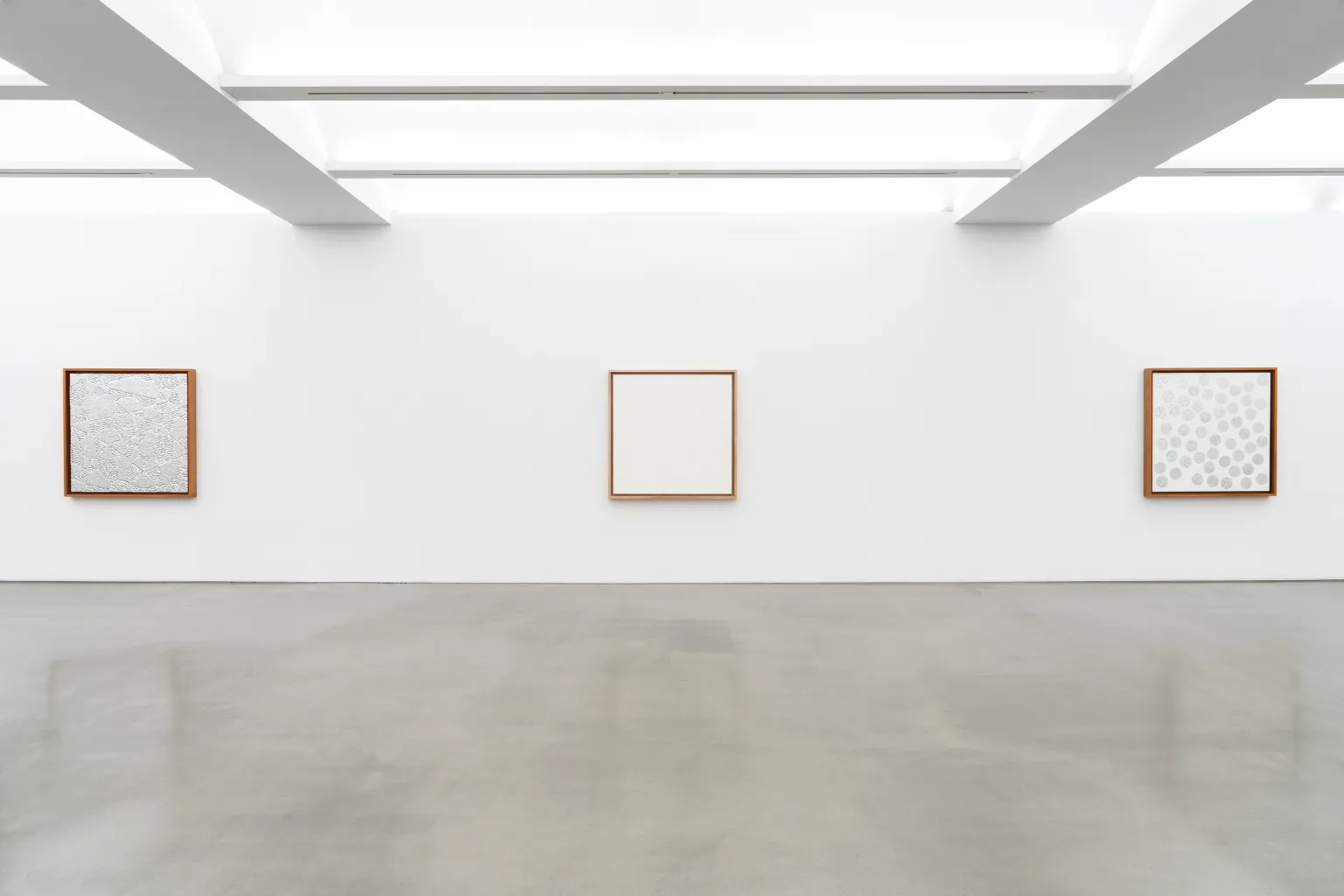
At the same time, the installation engages closely with the architecture of the space. The circular motifs serendipitously echoed the gallery’s columns, while the warm gallery lighting he had just set up contrasted perfectly with the cold surfaces of steel and concrete. Even the exhibition’s timing—opening March 5 and closing April 11—places it between winter and spring, a moment he unexpectedly saw reflected in the interaction between the works and the surrounding environment of snow, rain and shifting light.
As viewers move through the space, small reflective fragments catch the spotlights, producing flickering points of illumination that resemble constellations or open the surface into lively diamonds. “Yesterday, we were discussing how to illuminate the exhibition. This morning, I came back and looked closely at the works, and we decided to try turning off the ceiling lights,” he says. “Look how the light interacts with them. They become luminous bodies.”
Sometimes it seems as though Gabriel De la Mora is simply helping things find their place. Yet within this conscious relationship between the work and its broader spatial interactions, his architecture training also emerges, which, like that of many Mexican artists of his generation, gave him a particular understanding of materials and space. “In a way, these works are like architecture without function or service. They are sculptures, but they also resemble mechanical models,” he acknowledges. One can still see the more geometrical—and architectural—dimension of these works in the drawings they follow, tracing the underlying geometry that structures the entire project: compositions built from straight lines and circles. “I always begin with drawings. I don’t use computers or digital tools,” De la Mora explains, acknowledging how his process might even feel old-fashioned, almost like something from the 1980s. Rather than relying on digital tools, he works deliberately at a drafting table in an analog way, using millimetric paper, parallel rulers, pencils and sheets of mylar. “I place one sheet next to another, constructing the geometry step by step. The structure always begins with lines and circles, and then the images appear through reflections and repetitions within that geometry,” he explains.
These drawings form an extensive archive for each work, and he considers them artworks in their own right. The process itself has become so central to the practice that he imagines it could form the basis of an exhibition devoted entirely to the making of the work. The studio drawings, he notes, reveal another dimension of the practice—one that almost resembles a performance involving direct engagement with the structure of reality, yet from a very different perspective: one that no longer follows the strictly anthropocentric, dominant and extractive approach, but rather applies a more ancient intelligence of materials, more attuned to the complex relationship between human making and broader cosmic orders.
It is a system of exchanges and interrelations that De la Mora not only encourages viewers to acknowledge but also actively engages with himself, subtly repositioning them within a dynamic shift in perspective. He connects the process to curiosity and play, recalling his father—a professor of philosophy—who told him that children are, in fact, the best philosophers because they discover the world by constantly asking why. That sense of continuous questioning and wonder, he says, remains central to his work. Playfully triggering our curiosity through his exploration and manipulation of material presences, his artwork encourages us to look at it—and at the world around us—with the same childlike attitude: free from rigid scientific, ideological or political infrastructures, and with fresh eyes.
¿Cuántas imágenes pueden estar contenidas dentro de una sola imagen? O, dicho de otro modo, ¿cuántas realidades distintas pueden existir sobre una superficie monocroma aparentemente simple, compuesta por miles de micropatrones que interactúan con la luz y el espacio de diferentes maneras? Durante casi una década, el artista mexicano Gabriel de la Mora ha buscado una forma de pintar sin pintura, utilizando en su lugar fragmentos orgánicos e inorgánicos del universo para ensayar nuevas simbiosis y sinergias de belleza, donde el mundo creado por el ser humano aún pueda encontrar cierta ilusión de armonía y orden cósmico dentro del curso entrópico más amplio de la naturaleza.
Al asumir y entrelazar los legados del minimalismo y el arte povera, De la Mora ha formulado su propia forma singular de abstracción orgánica y cósmica, donde el micro y el macrocosmos colisionan. Coleccionando obsesivamente restos tanto del mundo construido como del natural —cáscaras de huevo, suelas de zapatos, rejillas de altavoces, plumas, mariposas y piedras—, se involucra en una arqueología material que busca nuevas formas de taxonomía y clasificación. Las composiciones resultantes son visual y alquímicamente armónicas, profundamente sintonizadas con las propiedades intrínsecas de los materiales y su entorno.
En estas “vidas posteriores” de los materiales, el elemento original casi desaparece, revelando los ciclos continuos de acumulación y erosión que rigen todas las cosas, a medida que las entidades se convierten en partículas y fragmentos solo para tomar forma nuevamente en nuevas configuraciones dentro del círculo infinito de la entropía y la transformación. “Todo comienza con la fragilidad del material y la tensión que surge de esa fragilidad. El material puede estar fragmentado, pero a través de la forma encuentra una nueva resistencia y una nueva fuerza”, dice De la Mora a Observer mientras recorremos su más reciente exposición en Perrotin. El título de la muestra, “Repeated Original”, alude a ello, revelando a un artista cuya práctica existe en relación y colaboración con los ciclos más amplios de la materia.
“La idea es llevar la pintura a su mínima expresión, pero a través del máximo tiempo, trabajo y esfuerzo. Se mueve de lo mínimo a lo máximo, y luego regresa a lo mínimo”, explica. La serie que presenta aquí es la culminación de esta búsqueda incansable a través de distintos materiales. En su serie CaCO₃ —nombrada por la fórmula química del carbonato de calcio—, la cáscara de huevo blanca se convierte en el componente principal, utilizada mediante fragmentación y repetición para crear un nuevo conjunto monocromo.
“Siempre hay un diálogo con la abstracción”, señala De la Mora. “Para mí, todo es formal y conceptual. Todo se convierte en un monocromo, en una abstracción y en una repetición de imágenes con diferencias”. A menudo utiliza la analogía de los píxeles digitales: una imagen compuesta por un solo píxel, 20 píxeles en una cuadrícula o 20,000 píxeles formando una imagen realista pueden representar el mismo sujeto. De manera similar, su obra oscila entre estructuras micro y macro, explorando correspondencias dentro de la arquitectura más amplia de la realidad.
En este ciclo repetitivo de fragmentar, destruir y reensamblar, la obra comienza a asemejarse a una forma de meditación, evocando la filosofía japonesa del wabi-sabi, con su aceptación de la impermanencia y la transformación. De la Mora describe su práctica como una forma activa de meditación, una relación constante con la materia que requiere sintonizarse con sus propiedades físicas para guiar estos fragmentos hacia su siguiente forma. “Siempre estoy jugando con lo micro y lo macro —las correspondencias, la estructura de la realidad—. Requiere mucha disciplina, pero también se vuelve algo meditativo. Me volví un poco obsesivo con la serie, pero cuando ves cómo la luz interactúa con ella, se vuelve increíble”.
Este compromiso inventivo con las materias primas resuena con la tradición artesanal compartida en muchas culturas latinoamericanas, donde los vínculos con saberes ancestrales han preservado una inteligencia material poco común. En muchos contextos de América Latina, reconoce, los artistas han trabajado con materiales humildes o residuales, desarrollando un ethos de transformación artesanal. Para él, la transformación es el concepto central: objetos creados originalmente para funciones prácticas adquieren nuevos significados una vez que estas terminan. “Mi definición de arte es simple: el arte no se crea ni se destruye, se transforma”, afirma. “Si tuviera que reducir mi trabajo a una palabra, sería transformación: una transformación química o alquímica, un cambio de estado”.
De esta reflexión surge el título de la exposición. “Lo original es único, pero nunca hay dos cosas idénticas. La repetición verdadera no existe, porque siempre hay diferencias. No hay dos ADN iguales, ni voces, ojos o huellas dactilares idénticas. Nunca encontrarás dos personas exactamente iguales”, explica, señalando cómo aún es posible redescubrir la belleza en la armonía a través del acto de componer fragmentos. Sus instalaciones son refinadas, incluso luminosas, pero siguen siendo profundamente materiales, construidas a partir de sustancias físicas y trabajo manual.
Este cuerpo de obra surge de su intento continuo de “pintar sin pintura”, constante en su práctica: expandir la pintura más allá del pigmento tradicional para relacionarse con la propia materia de la realidad como imagen, y con las infinitas imágenes posibles ya presentes en el movimiento continuo de partículas que se coagulan en formas. Las obras funcionan simultáneamente como dibujos, pinturas y esculturas, combinando estructura lineal, superficie y presencia tridimensional, mientras mantienen un lenguaje formal de abstracción monocroma y variación sutil.
“De nuevo, todo aquí es formal y conceptual. Todo se convierte en un monocromo, una abstracción y una repetición de imágenes con diferencias”, enfatiza. Sin embargo, lo que busca es que el espectador experimente el proceso, el material y la forma. “El primer impacto de cualquier obra siempre es visual: entra por los ojos, por lo formal y por la emoción. Luego la contemplación empieza a generar preguntas. Algo te mueve emocionalmente y luego te hace pensar. Para mí, eso es lo mejor que puede pasar en el arte”. Ambas dimensiones —formal y conceptual— son inseparables: “Si falta una, falta todo”, dice sonriendo.
Aun así, De la Mora sostiene que incluso la dimensión conceptual pertenece en última instancia al espectador. Quiere dejar la interpretación final abierta. “El arte es para todos. No necesitas saber de arte para ver arte. Si tienes ojos, lo verás y pensarás; y si no, puedes experimentarlo a través del tacto u otros sentidos. El arte tiene que hablarle al espectador en múltiples direcciones”.
Reforzó esta idea en su reciente exposición en el Museo Jumex en Ciudad de México, donde durante seis meses realizó 79 visitas guiadas y descubrió que los visitantes encontraban significados que él mismo no había identificado.
Su decisión de dejar abierta la composición material también se refleja en los títulos: utiliza únicamente números que describen los elementos, evitando imponer interpretaciones, en un método cercano a la taxonomía. “Podrías llamarlo un enfoque científico, pero para mí está más cerca de la filosofía: hacer preguntas en muchas direcciones”.
Su práctica combina una aproximación científica a los materiales —desde su química y física— con una dimensión filosófica y espiritual. “Me encanta cómo una idea puede generar una obra, la obra una serie y la serie un nuevo medio”, dice, subrayando el carácter experimental de su trabajo. En su estudio explora constantemente nuevos materiales, buscando la “ecuación” que transforme su aparente entropía en un orden comprensible.
De esta exploración surgió el uso de esferas de vidrio recubiertas de aluminio, que introducen un giro óptico: superficies cóncavas y convexas generan imágenes inestables que se multiplican según el punto de vista. Las cáscaras de huevo actúan como separadores, creando la sensación de múltiples planos en una superficie plana. A medida que el espectador se mueve, las reflexiones cambian y parecen animar la obra, aunque el movimiento en realidad pertenece al observador.
Como la dislexia puede invertir los caracteres escritos, estas obras invierten la percepción: lo que parece subir baja, y viceversa. “Soy disléxico. Escribo al revés, como en espejo. Esto es casi una dislexia visual”, explica.
La instalación también dialoga con la arquitectura del espacio, con formas circulares que resuenan con las columnas de la galería y una iluminación que transforma las superficies en cuerpos luminosos.
A veces parece que Gabriel de la Mora simplemente ayuda a que las cosas encuentren su lugar. Pero en esta relación consciente entre obra y espacio también emerge su formación como arquitecto. “De alguna manera, estas obras son como arquitectura sin función”, dice.
Todo comienza con dibujos realizados de forma analógica —papel milimétrico, reglas, lápices— construyendo geometrías de líneas y círculos. Estos dibujos forman un archivo que él considera también obra.
Su práctica, finalmente, es un sistema de relaciones e intercambios que invita al espectador a cambiar de perspectiva. Inspirado por su padre, profesor de filosofía, recuerda que los niños son los mejores filósofos porque siempre preguntan “por qué”. Esa curiosidad permanece en su obra: una invitación a mirar el mundo con ojos nuevos, libres de estructuras rígidas, con una actitud abierta y lúdica.
No items found.