Gabriel de la Mora, a prominent visual artist, is the new Distinguished University Professor at the University of Colima.
Gabriel de la Mora, destacado artista visual, nuevo Maestro Universitario Distinguido de la Universidad de Colima
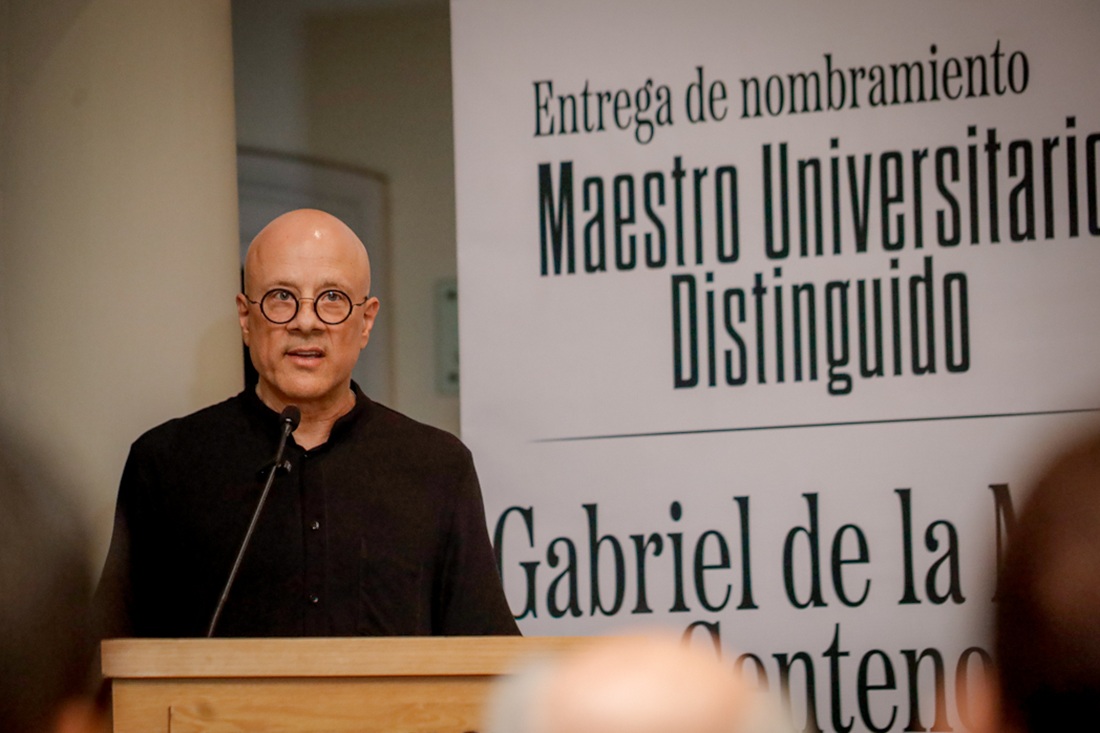
During an event held at the Pinacoteca Universitaria, the Universidad de Colima awarded visual artist Gabriel de la Mora Centeno the title of Distinguished University Master
Durante un evento celebrado en la Pinacoteca, la Universidad de Colima (UdeC) entregó el título de Maestro Universitario Distinguido al artista visual Gabriel de la Mora Centeno
30.4.2026
General Directorate of Press of the University of Colima
Por Dirección General de Prensa de la Universidad de Colima para El Comentario Digital
During an event held at the Pinacoteca Universitaria, the Universidad de Colima awarded visual artist Gabriel de la Mora Centeno the title of Distinguished University Master, “for his contributions to contemporary art in Mexico and for a career as an artist widely recognized by both the public and specialized critics, one that underscores the cultural value of memory and human communication in building an influential and diverse reality.”
In his remarks, Gabriel de la Mora admitted that, although visual expression is his strongest language as an artist, he took the time to write words of thanks for the first time:
“I receive this distinction with gratitude, but also with a profound sense of responsibility, because recognition coming from an academic institution does not only look toward the past—it also challenges the present and commits us to the future.”
The artist reflected on the beginning of his artistic career in August 1996:
“That was the year I made a decision that would shape my life: to leave architecture, close my firm, Catálisis Arquitectos, and dedicate myself fully to art. That same year I presented my first solo exhibition, La inconsciencia de la vista, at the Museo Regional de Historia de Colima.”
De la Mora also recalled a formative memory from when he was four years old, sitting in his classroom and writing a page of mirrored lowercase L’s from right to left:
“I remember my teacher correcting me and showing me the ‘proper’ direction. I obeyed. But when I finished, without anyone asking, I turned the page over and repeated the exercise in mirror writing. It wasn’t a mistake—it was a form of thought, a different way of organizing the world.”
That page, preserved by his mother for decades, was later presented as his first artwork in the exhibition La Petite Mort at the Museo de Arte Contemporáneo de Monterrey (MARCO) in 2026, co-organized with the Museo Jumex.
“In that page, I discovered something that had in fact always been there. Over time, I’ve come to understand that many things once labeled as deviations were actually possibilities. The only way to be different is to be oneself.”
De la Mora noted that educational systems—and many social structures more broadly—have traditionally been designed under the premise of homogeneity.
“The reality is different. Not all of us think, learn, or perceive in the same way. For a long time, I felt out of place in certain academic spaces because of differences in my cognitive processes.”
In that context, he explained:
“Drawing emerged not only as an artistic practice but as a form of knowledge. What was once identified as dyslexia ceased to be a limitation and became a tool—to see differently, to react differently, to persist where others dismiss.”
He went on to openly share:
“I am left-handed, dyslexic, have traits within the autism spectrum, and live with obsessive-compulsive disorder.”
He added that today there is a different framework for understanding these experiences: neurodiversity.
“A concept that does not deny difficulty, but neither does it reduce human experience to it. It opens the possibility of understanding difference not as error, but as variation.”
The artist emphasized that his neurodivergence is inseparable from his artistic practice:
“My work does not seek to represent a preconceived idea, but rather to construct a system based on repetition with difference, on error as a point of departure, on the mirror as structure, and obsession as method. I work through insistence, minimal variation, accumulation. It is not about making an image, but sustaining a process. Not about controlling the outcome, but allowing it to emerge. In that sense, my artistic practice is also a form of thought.”
For De la Mora, receiving this distinction from the University of Colima carries particular significance, as he long felt he inhabited a liminal space between two paths: art and academia.
“Today, that margin becomes a bridge. But there is still much more to do, especially in education.”
Recognizing neurodivergence, he added, is not simply a matter of language:
“It requires rethinking methodologies, evaluations, and forms of support. Equality does not mean treating everyone the same way, but creating the conditions for each person to fully develop their capacities.”
Before concluding, he thanked all those who have accompanied him along his path:
“Every day I do what I love most: art. And I do it not from certainty, but from questioning; not from answers, but from search. I accept this recognition as a renewed responsibility: the responsibility to keep working, questioning, and proposing. Because art, like knowledge, is never static.”
Following his speech, the audience in the Salón del Vitral rose for a prolonged standing ovation.
Taking the floor afterward, University Rector Christian Torres Ortiz stated that this recognition is awarded to individuals whose work, thought, and trajectory have significantly enriched both institutional values and humanity itself.
“It is an honor for the University to bestow this distinction upon one of the most important contemporary artists in our country, whose career is distinguished by rigorous, substantial, and deeply significant artistic production.”
The rector also warmly remembered the artist’s father, Gabriel de la Mora de la Mora, describing him as a beloved university professor who contributed to the education of hundreds of Colima citizens.
Speaking of Gabriel de la Mora’s career, he noted that it was precisely thirty years ago that the artist began his trajectory in one of the University’s museums.
“Since then, his professional development has been steady and remarkable, leading him to exhibit in some of the most important contemporary art museums in Mexico and Latin America. His work has now been shown across all five continents, confirming its international relevance and enduring significance.”
Before concluding, the rector invited De la Mora to participate in the celebrations for the thirtieth anniversary of the University Pinacoteca through a major exhibition of his work.
“For the University of Colima and for the people of Colima, it would be an honor—a true privilege—to realize this exhibition and continue strengthening our shared history of art, thought, and cultural commitment. I also invite you to help us build that bridge between art and academia represented by the University of Colima.”
Carlos Ramírez Vuelvas reviewed the artist’s career, highlighting his recent exhibition at Museo Jumex, one of the leading museums in Mexico and Latin America, which surveyed more than twenty-two years of his work.
He also emphasized the artist’s sustained connection to Colima and the University through lectures and workshops at the Instituto Universitario de Bellas Artes and the Faculty of Architecture, as well as his 2022 exhibition at the University Pinacoteca, El poder es el autor que desaparece.
“Today he receives the investiture of Distinguished University Master—the first academic distinction granted to him in recognition of his artistic achievements.”
The event’s artistic program concluded with a performance by acclaimed classical guitarist and composer Simone Iannarelli, who performed two of his own compositions.
Durante un evento celebrado en la Pinacoteca, la Universidad de Colima (UdeC) entregó el título de Maestro Universitario Distinguido al artista visual Gabriel de la Mora Centeno, “por sus aportaciones al arte contemporáneo en México y su trayectoria como artista, ampliamente reconocida por el público y la crítica especializada, que subraya el valor cultural de la memoria y la comunicación humana para construir una realidad influyente y diversa”.
En su discurso, Gabriel de la Mora confesó que, aunque como artista su mejor forma de expresión es visual, se tomó el tiempo para escribir, por primera vez, unas palabras de agradecimiento: “Recibo esta distinción con gratitud, pero también con una profunda conciencia de responsabilidad, porque los reconocimientos, cuando vienen de una institución académica, no solo miran hacia el pasado, también interpelan el presente y comprometen el futuro”.
El artista recordó los inicios de su carrera artística, en agosto de 1996: “Año en el que tomé una decisión que marcaría mi vida: dejar la arquitectura, cerrar mi despacho Catálisis Arquitectos y dedicarme por completo al arte. Ese mismo año presenté mi primera exposición individual, ‘La inconsciencia de la vista’, en el Museo Regional de Historia de Colima”.
De la Mora Centeno recordó al niño que fue a los 4 años, en su salón de clases, cuando escribió una plana de la letra ele hecha en espejo, de derecha a izquierda: “Recuerdo a la maestra corrigiéndome e indicándome la dirección ‘correcta’; yo obedecí. Al terminar, sin que nadie me lo pidiera, volteé la hoja y repetí el ejercicio en espejo. Esto no era un error, era una forma de pensamiento, una manera distinta de organizar el Mundo”.
Esa hoja, la cual guardó su madre por décadas, fue presentada como su primera obra en la exposición “La Petite Mort” (Museo de Arte Contemporáneo de Monterrey, MARCO, 2026, coorganizada con el Museo Jumex). “En esa hoja descubrí algo: en realidad, siempre había estado presente. Con el tiempo he entendido que muchas de las cosas que en algún momento fueron señaladas como desviaciones eran en realidad posibilidades. La única forma de ser diferente es ser uno mismo”.
De la Mora Centeno dijo que el sistema educativo y en general muchas estructuras sociales fueron diseñadas bajo la premisa de la homogeneidad. “La realidad es otra. No todos pensamos, aprendemos o percibimos de la misma manera. Durante mucho tiempo me sentí fuera de lugar en ciertos espacios académicos por una diferencia en los procesos”.
En ese contexto, destacó: “El dibujo apareció no solo como una práctica artística, sino como una forma de conocimiento; lo que se identificaba como dislexia dejó de ser una limitación para convertirse en una herramienta, para ver distinto, para reaccionar distinto, para insistir donde otros descartan”.
“Soy zurdo, disléxico, con rasgos dentro del espectro autista y con un trastorno obsesivo-compulsivo”, confesó. “Hoy, en cambio, contamos con un marco distinto: el de la neurodiversidad. Un concepto que no niega las dificultades, pero que tampoco reduce la experiencia humana a ellas. Un concepto que abre la posibilidad de entender la diferencia no como error, sino como variación”.
El homenajeado señaló que hoy en día no se puede entender su trabajo sin esa condición de ser neurodivergente: “Mi obra no busca representar una idea previa, sino construir un sistema basado en la repetición con diferencia, en el error como punto de partida, en el espejo como estructura y en la obsesión como método. Trabajo desde la insistencia, desde la variación mínima, desde la acumulación. No se trata de hacer una imagen, sino de sostener un proceso. No se trata de controlar el resultado, sino de permitir que emerja. En ese sentido, mi práctica artística es también una forma de pensamiento”.
Para el artista, el reconocimiento que le hace la Universidad de Colima tiene un significado muy particular, ya que durante mucho tiempo sintió que habitaba un margen entre 2 rumbos: el del arte y el de la academia. “Hoy, ese margen se vuelve un puente, pero aún hay mucho más que hacer, particularmente en el ámbito educativo”.
Reconocer la neurodivergencia -añadió- “no es solo una cuestión de lenguaje, sino que implica repensar metodologías, evaluaciones y formas de acompañamiento. Implica aceptar que la igualdad no consiste en tratar a todos de la misma manera, sino en generar condiciones para que cada uno pueda desarrollar sus capacidades”.
Antes de concluir, Gabriel de la Mora agradeció a quienes han sido parte de este camino: “Hago cada día lo que más amo: el arte, y lo hago no desde la certeza, sino desde la pregunta; no desde la respuesta, sino desde la búsqueda. Asumo este reconocimiento como una responsabilidad renovada: la responsabilidad de seguir trabajando, de seguir cuestionando, de seguir proponiendo. Porque el arte, como el conocimiento, no es estático”.
Tras escuchar su discurso, el público presente en el Salón del Vitral le brindó de pie un largo aplauso.
Al tomar la palabra, el Rector señaló que este reconocimiento ha sido conferido a las personalidades que, a través de su obra, su pensamiento y trayectoria han contribuido de manera significativa a engrandecer los valores institucionales y de la humanidad. “Es un honor para la Universidad entregar esta distinción a uno de los artistas contemporáneos más importantes de nuestro país, cuya carrera se distingue por una producción artística sólida, rigurosa y de gran trascendencia”.
Christian Torres Ortiz recordó con especial apreció al padre del homenajeado, el profesor Gabriel de la Mora de la Mora, “entrañable maestro universitario que contribuyó a la formación de cientos de ciudadanos y ciudadanas colimenses”.
Al hablar de Gabriel de la Mora, el Rector señaló que fue precisamente hace 30 años que inició su trayectoria artística en uno de los museos de la UdeC. “A partir de entonces, su desarrollo profesional ha sido constante y notable, llevándola a exponer su obra en algunos de los museos de arte contemporáneo más importantes de México y de América Latina. Además, su trayectoria ha sido exhibida en los 5 continentes, lo que confirma la proyección y vigencia internacional de su obra”.
Antes de concluir su intervención, el Rector invitó al homenajeado a formar parte de los festejos por el trigésimo aniversario de la Pinacoteca Universitaria mediante la realización de una exposición de su obra. “Para la Universidad de Colima y para el pueblo colimense será un honor, un verdadero privilegio concretar esta muestra y seguir fortaleciendo juntos una historia compartida de arte, pensamiento y compromiso cultural. Por último, te quiero invitar a que nos ayudes a construir ese puente entre el arte y la academia representada por la Universidad de Colima”.
Carlos Ramírez Vuelvas, coordinador general de Extensión, reseñó la trayectoria del artista destacando su más reciente exposición en el Museo Jumex, uno de los más importantes de México y Latinoamérica, la cual abarcó más de 22 años de su trabajo. “Gabriel de la Mora ha mantenido un vínculo constante con Colima y la Universidad, impartiendo conferencias y talleres en el Instituto Universitario de Bellas Artes (IUBA) y la Facultad de Arquitectura. En 2022 expuso en la Pinacoteca Universitaria, ‘El poder es el autor que desaparece’. El día de hoy recibe la investidura como Maestro Universitario Distinguido, la primera distinción académica que se le otorga por los méritos de su trayectoria artística”.
El momento artístico estuvo a cargo de Simone Iannarelli, destacado guitarrista clásico y compositor quien interpretó 2 piezas de su autoría.
No items found.