Entre arte y deporte, Abel Quezada gains relevance in social and political events
Entre arte y deporte, Abel Quezada cobra relevancia en el acontecer social y político
Museo Kaluz opens today an exhibition with 82 works by the cartoonist
El Museo Kaluz inaugura hoy una muestra con 82 obras del caricaturista
4.7.2026
Eder Torres
Eder Torres
The illustrations of Abel Quezada (1920-1991) are so relevant that they could be published tomorrow and still have informative value, noted Ery Camara Thiam, in charge of the curatorial concept of the exhibition ¡México-México-México! Abel Quezada between art and sport , during a tour of the exhibition that opens today.
Mounted at the Kaluz Museum to coincide with the 2026 FIFA World Cup, the exhibition brings together 82 works by the Monterrey-born cartoonist—including cartoons, paintings, watercolors, and previously unseen archival material—that showcase his passion for sports such as baseball, boxing, tennis, and soccer. Beyond the realm of sports, the selection highlights the humor, irony, and sharp social commentary that defined his artistic output.
The exhibition also highlights two of his lesser-known facets: his work as a filmmaker and his painting. Although he began painting at the age of 45, after a long career as a draftsman, he approached this discipline with humility. “He was very respectful of art because he didn't consider himself a professional painter; he said he was a Sunday painter,” explained Camara Thiam, who is also responsible for the conservation of the cultural center's collections.
“It wasn’t until 1984 that he exhibited two of his paintings for the first time. Then, the public told him, ‘You can’t keep what you paint to yourself; we need to see it.’ That’s when he loosened up and began showing his work in galleries and museums.” As an artist, Quezada was so modest that he didn’t participate in the art market. “He always lent his works to his friends; he never sold them.” The curator pointed to the case of a piece on the back of which the cartoonist left a message: “I’m lending it to the Tamayo Museum for 99 years.”
Mexico-Mexico-Mexico! Abel Quezada between art and sport –comprised of material from the Quezada Rueda Family Collection (whose archive safeguards more than 16,000 pieces), the Proyectos Monclova Gallery, the Kaluz Museum and private collections–, is organized into three sections: one as a presentation and two more on sports, in addition to an interactive room where the public can engage with the exhibition, both by reading books and catalogs, and by illustrating and bringing to life the cartoonist's creations.
The first section, titled The Many Faces of Abel Quezada , contextualizes his career through photographs, documents, early works, and personal objects: travel journals, brushes, and paintbrushes—"his tools of the trade." Quezada "didn't go to school to study drawing; it came naturally to him. It was his language." The exhibition brings together everything from the first cartoons he sent by mail from Tamaulipas to various newspapers in Mexico City when he was 14, to the covers he illustrated for The New Yorker between 1981 and 1987, with the aim of showcasing the evolution of his work.
The exhibition "The Game: Between Art and Sport," Part Two, presents Quezada's pictorial production, which he began as a self-taught artist in 1965. Jockeys, runners, tennis and billiards players, baseball players, boxers, reporters, and fans reveal personal memories and passions. Along the way, one can encounter immortal figures such as Fernando Valenzuela and Gerardo " Kid " González. Free from academic conventions, the artist constructed his own humorous and lyrical language, characterized by its freshness.
Satire of the fans
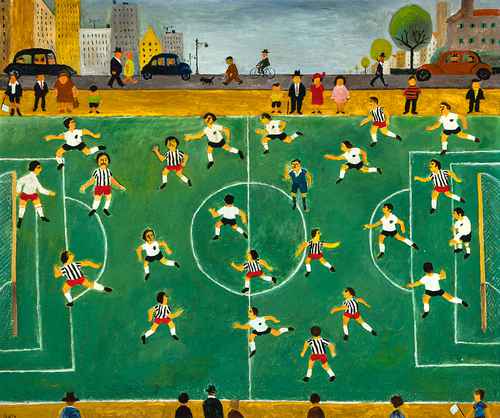
The third section, "Criticism and Humor on the Field ," and the most relevant of all, features oil paintings, watercolors, and cartoons about soccer published in the newspapers Ovaciones , Excélsior , Novedades , and Últimas Noticias . Through his creations, Quezada offered critique and satire of the reality of the Mexican people and their passion for the sport. His work not only depicts soccer teams competing on the field, but also portrays the sport as a social phenomenon shaped by political, economic, and media interests.
Sixty years after some of the cartoons on display were created, Ery Camara and the illustrator's son, named Abel like his father, confessed their surprise at the enduring relevance of the material. "We could publish two or three, or all of them, and they would still be very current."
Camara Thiam, for his part, emphasized the relevance of the work of the artist who was recognized in 1989 by Time magazine as one of the 10 best cartoonists in the world, because “he used to combine drawing with his own literature. He wrote the texts himself, and that combination holds an eloquence that transcends time.”
Throughout these three sections, the public will find characters, symbols and images representative of Mexican public life and culture: the train as a historical character, Carlos Monsiváis, María Félix, public officials, former presidents, writers, intellectuals and athletes, as well as the famous Tapado and the dog Solovino , two of Abel Quezada's most emblematic creations.
"Mexico-Mexico-Mexico! Abel Quezada between art and sport" will be available until August 31, from Wednesday to Monday, from 10 a.m. to 6 p.m., at the Kaluz Museum, located at Avenida Hidalgo 85, in the Historic Center of the capital.
Las ilustraciones de Abel Quezada (1920-1991) son tan vigentes que podrían publicarse mañana y aún tendrían relevancia informativa, señaló Ery Camara Thiam, encargado del concepto curatorial de la exposición ¡México-México-México! Abel Quezada entre arte y deporte, durante un recorrido por la muestra que se inaugura hoy.
Montada en el Museo Kaluz con motivo de la Copa Mundial de la FIFA 2026, la exposición reúne 82 obras del dibujante regiomontano –entre cartones, pinturas, acuarelas y material de archivo inédito– que dan cuenta de su afición por disciplinas como el béisbol, el boxeo, el tenis y el futbol. Más allá del ámbito deportivo, la selección pone de relieve el humor, la ironía y la aguda crítica social que definieron su producción artística.
La muestra recupera además dos de sus facetas menos conocidas: la de cineasta y la de pintor. Aunque comenzó a pintar a los 45 años, después de una larga trayectoria como dibujante, se acercó a esta disciplina con humildad. “Era muy respetuoso del arte porque no se consideraba un pintor profesional; decía que era un pintor de domingos”, explicó Camara Thiam, también responsable del área de conservación de las colecciones del recinto cultural.
“No fue sino hasta 1984 en que expuso por primera vez dos de sus cuadros. Entonces, el público le dijo: ‘No puedes guardar lo que pintas, necesitamos conocerlo’. Fue cuando se soltó y presentó su obra en galerías y museos”. Como artista, Quezada fue tan modesto que no participó en el mercado del arte. “Siempre prestó sus obras a sus amigos, no las vendió”. El curador señaló el caso de una pieza en la que, al reverso, el caricaturista dejó un mensaje: “Se lo presto al Museo Tamayo por 99 años”.
¡México-México-México! Abel Quezada entre arte y deporte –conformada por material de la Colección Familia Quezada Rueda (cuyo archivo resguarda más de 16 mil piezas), la Galería Proyectos Monclova, el Museo Kaluz y de particulares–, está organizada en tres núcleos: uno a modo de presentación y dos más sobre deportes, además de una sala interactiva en la que el público podrá apropiarse de la exposición, tanto con la lectura de libros y catálogos, como para ilustrar y dar vida a las creaciones del caricaturista.
La primera sección, titulada Los múltiples rostros de Abel Quezada, contextualiza su trayectoria a través de fotografías, documentos, obras tempranas, así como objetos personales: cuadernos de viaje, pinceles y brochas, “sus herramientas de trabajo”. Quezada “no entró en una escuela para estudiar dibujo; lo tenía naturalmente. Era un lenguaje suyo”. El recorrido reúne desde los primeros cartones que enviaba a los 14 años por correo desde Tamaulipas a distintos periódicos de la Ciudad de México, hasta las portadas que ilustró para The New Yorker entre 1981 y 1987, con el propósito de mostrar la evolución de su obra.
El juego: entre arte y deporte, la segunda parte, presenta la producción pictórica de Quezada, que inició de manera autodidacta en 1965. Jinetes, corredores, jugadores de tenis y billar, beisbolistas, boxeadores, reporteros y aficionados revelan recuerdos y pasiones personales. En el recorrido es posible encontrar a figuras inmortales como Fernando Valenzuela y Gerardo, Kid, González. Libre de convenciones académicas, el artista construyó un lenguaje propio, humorístico y lírico, caracterizado por la frescura.
Sátira a la afición
El tercer núcleo, Crítica y el humor en la cancha, y el más vigente de todos, recupera óleos, acuarelas y cartones sobre futbol publicados en los periódico Ovaciones, Excélsior, Novedades y Últimas Noticias. A través de sus creaciones, Quezada hizo crítica y sátira sobre la realidad del pueblo mexicano y su afición al deporte. Su obra no sólo representa a equipos de futbol disputándose una cancha, sino al deporte como un fenómeno social atravesado por intereses políticos, económicos y mediáticos.
A 60 años de la realización de algunas de las caricaturas exhibidas en la muestra, Ery Camara y el hijo del ilustrador, nombrado Abel al igual que su padre, se confesaron sorprendidos por la vigencia del material. “Podemos publicar dos o tres o todos y serían muy actuales”.
Camara Thiam, por su parte, enfatizó en la relevancia de la obra de quien fue reconocido en 1989 por la revista Time como uno de los 10 mejores dibujantes del mundo, pues “solía combinar el dibujo con su propia literatura. Él mismo escribía los textos, y esa combinación guarda una elocuencia que trasciende el tiempo”.
A lo largo de estas tres secciones, el público encontrará personajes, símbolos e imágenes representativos de la vida pública y la cultura mexicana: el tren como personaje histórico, Carlos Monsiváis, María Félix, funcionarios públicos, ex presidentes, escritores, intelectuales y deportistas, así como el famoso Tapado y el perro Solovino, dos de las creaciones más emblemáticas de Abel Quezada.
¡México-México-México! Abel Quezada entre arte y deporte estará disponible hasta el 31 de agosto, de miércoles a lunes, de las 10 a las 18 horas, en el Museo Kaluz, ubicado en avenida Hidalgo 85, en el Centro Histórico capitalino.
No items found.